Sunday, February 22, 2026

A darker view of the Three of Pentacles


Since June 9, 2024, I have seen the Three of Pentacles as being primarily a dark or negative card, even though Waite's Pictorial Key to the Tarot assigns it a positive meaning. Here I want to explore this darker view of the card, incorporating some comments by Bill Wright on my post "All the pebbles I have seen."


1. Working in the dark to build a church from secret plans

Bill notes that on the card, "men are working on/ in a Cathedral or Church," and

The Three of Pentacles shows these men working literally in the dark - the men are juxtaposed against a completely black background and environment while they discuss their plans.

He further notes that the man on the left, wearing an apron and holding a maul, is a stonemason, thus suggesting Freemasonry and the Book of Mormon theme of "secret combinations." Working in darkness, secret plans, and (somewhat surprisingly) church-building are all portrayed in negative terms in the Book of Mormon. Many passages could be cited here, but one part of the book that hits on all of these themes is 2 Ne. 26-28, part of Nephi's long discourse that makes up two-thirds of that book:

And the Gentiles are lifted up in the pride of their eyes, and have stumbled, because of the greatness of their stumbling block, that they have built up many churches; . . . . And there are many churches built up which cause envyings, and strifes, and malice. And there are also secret combinations, even as in times of old, according to the combinations of the devil, for he is the founder of all these things; yea, the founder of murder, and works of darkness . . . . For behold, my beloved brethren, I say unto you that the Lord God worketh not in darkness (2 Ne. 26:22-23).

And wo unto them that seek deep to hide their counsel from the Lord! And their works are in the dark; and they say: Who seeth us, and who knoweth us? (2 Ne. 27:27, quoting Isa. 29:15)

For it shall come to pass in that day that the churches which are built up, and not unto the Lord, when the one shall say unto the other: Behold, I, I am the Lord's; and the others shall say: I, I am the Lord's; and thus shall every one say that hath built up churches, and not unto the Lord (2 Ne. 28:3).

Yea, and there shall be many which shall . . . seek deep to hide their counsels from the Lord; and their works shall be in the dark (2 Ne. 28:9).

Coming back to the Masonic angle -- and we must remember that A. E. Waite, the designer of this card, was himself a Mason and wrote several books on the subject -- it is perhaps significant that there are three men on the card and that the only Masonic implement detected is the Maul. In the legend of Hiram Abiff, which is part of a Master Mason's initiation, Hiram was murdered in the Temple of Solomon (which he had designed) by three ruffians, lesser Masons intent on extracting from him the secrets of a Master, and the weapon that dealt him the death blow was a Maul (sometimes called a Gavel). One Masonic pamphlet I've read (I can't seem to find it online) says that the Maul is the only Masonic implement to have no explicit moral lesson attached to it, and the writer proposes that, as the weapon with which Master Hiram was murdered, it should serve to remind us of the sanctity of life. In other words, the implement Waite chose to depict on this card is one which in Masonry has no other symbolic meaning than murder -- specifically, secret murder committed by members of an oath-bound fraternity.


The Three of Pentacles and the Devil

Nephi, quoted above, refers to "the combinations of the devil, . . . the founder of murder, and works of darkness." It is interesting to note, then, certain iconographic connections between the Three of Pentacles and the Devil card.

Besides the 14 cards of the suit of Pentacles, two of the Major Arcana also feature pentacles or pentagrams. A quick glance at all 16 cards incorporating this symbol shows that two of them stand out as different:


As you can see, almost all of the pentacles on these cards follow the same black-on-yellow color scheme. The only exceptions are the Three of Pentacles and the Devil:


Once this has been noticed, other correspondences between these two cards suggest themselves. The Devil's number is 15, and a trio of five-pointed stars represents the same number. In the Golden Dawn system, the Devil represents Capricorn, and the Three of Pentacles is the second decan of the same sign. Both cards have a black background, with gray and tan as the other dominant colors. Both show two figures standing on the floor and a third standing on a raised surface. This third figure raises the left hand ("left" from our point of view) and in the right holds an implement with its head angled downward.

On the Three of Pentacles, the implement is the Maul. On the Devil, it is a torch. However, John Opsopaus's Pythagorean Tarot offers a different interpretation of the Devil, portraying him as Hephaestus or Vulcan and putting in his hand what may look an awful lot like Dr. Evil's spaceship but is in fact "a large hammer or mallet."


I have connected the hammer-wielding mason on the Three of Pentacles with the murder of Hiram Abiff, as told in the Master Mason's degree. The password of the Master's degree is Tubal Cain. In the Bible, Tubal-cain is the first smith, "an instructer of every artificer in brass and iron" (Gen. 4:22), and a fanciful folk-etymology derives Vulcan from his name. Given the, uh, spaceship-like shape of the hammer on Opsopaus's card, it is significant that Masons typically portray the secret name Tubal Cain via the rebus "two-ball cane."


The name Cain is of course closely associated with secret combinations. The Jaredite secret combinations, we are told, "had been handed down even from Cain" (Ether 8:15), and Cain took a title that many have seen as a very thinly veiled reference to the rank of Master Mason:

And Cain said: Truly I am Mahan, the master of this great secret, that I may murder and get gain. Wherefore Cain was called Master Mahan, and he gloried in his wickedness (Moses 5:31).

Cain was succeeded in this title by Lamech, and thus perhaps by Lamech's son Tubal-cain (Moses 5:49). 


The Three and Nine of Pentacles

One February 13, 2026, I drew a single card from my Rider-Waite deck, put it face-down on the table in front of me, and, as is my usual practice, attempted to perceive it psychically before turning it face-up. I "saw" three pentacles arranged in a triangle and a figure in a red and yellow robe, so I very confidently predicted that it was the Three of Pentacles. When I turned it over, though, it was the Nine.


This false prediction made me notice parallels between these two cards that I'd never noticed before. On the right side of the Nine of Pentacles, we have three pentacles arranged in a triangle, much like those on the Three. On the left, we have this same triangular arragement -- this time oriented exactly like that on the Three -- repeated twice. As it happens, these are also the only two cards in the deck to show someone wearing a yellow garment with a pattern of red marks on it. The grapes on the Nine, together with the woman's curly hair, also suggest the female figure from the Devil card.

As I contemplated the card, I thought about the falcon. This is a bird known for its excellent eyesight, but on the card its eyes are covered with a hood, which made me think of the line "the seers hath he covered." As it happens, this line from Isaiah is quoted in the very section of 2 Nephi I cited above in reference to building churches and working in the dark.

For behold, the Lord hath poured out upon you the spirit of deep sleep. For behold, ye have closed your eyes, and ye have rejected the prophets; and your rulers, and the seers hath he covered because of your iniquity (2 Ne. 27:5).

I've always seen the Nine of Pentacles as a very positive card, and I still think that is its usual meaning. But every card has many meanings, and one of its meanings does seem to tie it to the Three.

Wednesday, November 12, 2025

Using three dice to consult the entire Tarot deck

As has been discussed many times on this blog, there are 21 possible rolls of two dice and 56 possible rolls of three dice. Thus, if you have a mapping system (such as the Seven Eleven), you can consult the Trumps Major by rolling two dice or the Minor Arcana by rolling three.

The problem, of course, is that one normally wants to consult the entire deck rather than deciding in advance whether you want Trumps or Minors. Unless you want to resort to using D&D dice (there are 78 possible rolls of 2d12), it's not obvious how to do that with dice.

I think I've finally come up with a workable method. You have to take into account not only the numbers rolled but the relative position of the three dice. Two dice are considered to be "linked" if they are touching, or if the space between them is narrower than the width of a die; if they are separated by one die-width or more, they are considered to be "unlinked." This allows for four possible patterns of throws, taking their names from Morse code for lack of anything better to call them:


The four patterns are:
  • O-pattern (three links): All three dice are very close together. Minor Arcana.
  • M-pattern (two links): One die is close to each of the other two, but the other two are not close together. Minor Arcana.
  • T-pattern (one link): Two dice are close together, and the third is isolated.The Trump corresponding to the two linked dice, ignoring the third.
  • S-pattern (no links): Each die is far from the others. Minor Arcana.
As before, you get the Fool if something unexpected happens, like one of the dice falling out of the dish or something. (I considered making the S-pattern the Fool, but that pattern occurs too frequently to make that viable.)

Further details of the layout of the dice could be used to add interpretive nuance. If it's a Minor, the O-pattern might indicate a stronger or more concentrated influence, while the S-pattern is weaker and more diffuse. In an M-pattern, one of the three dice is "central" and thus more prominent than the other two. For a Trump (T-pattern), the number on the third, isolated die can be taken into account.

Wednesday, October 22, 2025

The Seven Eleven system of Tarot-dice mapping

This system came to me in a dream ("Rolling the bones"), with the decision to rank Wands as the high suit the result of further dream experiments ("Pumping iron into a sword" and "Cat Eye forum").

You roll two ordinary six-sided dice to consult the Trumps Major and three to consult the Minor Arcana. (You get the Fool if something goes wrong, like one of the dice landing on its edge or falling off the table or something.) Each face of the die has its face value except for four and six. Four is counted as 7, and six is counted as 11. (Think of how the pips on the six are arranged in two vertical lines, like 11.) To calculate the value of a roll, you multiply the respective values of each die rather than adding them up.

For example, suppose you roll three dice and get one, three, and four. Four represents 7, and the other two have their face value.  The value of the roll is then 1 × 3 × 7 = 21.

The Trumps Major are mapped to the rolls of two dice in rank order according to their face value (in the Rider-Waite sequence), as follows, with "root trumps" (squares) in bold:

{1, 1} = 1 = I. The Magician
{1, 2} = 2 = II. The High Priestess
{1, 3} = 3 = III. The Empress
{2, 2} = 4 = IV. The Emperor
{1, 5} = 5 = V. The Hierophant
{2, 3} = 6 = VI. The Lovers
{1, 4} = 7 = VII. The Chariot
{3, 3} = 9 = VIII. Strength
{2, 5} = 10 = IX. The Hermit
{1, 6} = 11 = X. The Wheel of Fortune
{2, 4} = 14 = XI. Justice
{3, 5} = 15 = XII. The Hanged Man
{3, 4} = 21 = XIII. Death
{2, 6} = 22 = XIV. Temperance
{5, 5} = 25 = XV. The Devil
{3, 6} = 33 = XVI. The Tower
{4, 5} = 35 = XVII. The Star
{4, 4} = 49 = XVIII. The Moon
{5, 6} = 55 = XIX. The Sun
{4, 6} = 77 = XX. Judgement
{6, 6} = 121 = XXI. The World

The Minor Arcana are ranked first by suit (with Wands high) and then by rank within that suit. In accordance with longstanding tradition, Aces are high for the round suits and low for the long suits. The cubes are bolded as equivalent to the root trumps. Rolls with no repeated numbers, which have the highest probability, are italicized.

{1, 1, 1} = 1 = Ten of Pentacles
{1, 1, 2} = 2 = Nine of Pentacles
{1, 1, 3} = 3 = Eight of Pentacles
{1, 2, 2} = 4 = Seven of Pentacles
{1, 1, 5} = 5 = Six of Pentacles
{1, 2, 3} = 6 = Five of Pentacles
{1, 1, 4} = 7 = Four of Pentacles
{2, 2, 2} = 8 = Three of Pentacles
{1, 3, 3} = 9 = Two of Pentacles
{1, 2, 5} = 10 = Ace of Pentacles
{1, 1, 6} = 11 = Page of Pentacles
{2, 2, 3} = 12 = Knight of Pentacles
{1, 2, 4} = 14 = Queen of Pentacles
{1, 3, 5} = 15 = King of Pentacles
{2, 3, 3} = 18 = Ace of Swords
{2, 2, 5} = 20 = Two of Swords
{1, 3, 4} = 21 = Three of Swords
{1, 2, 6} = 22 = Four of Swords
{1, 5, 5} = 25 = Five of Swords
{3, 3, 3} = 27 = Six of Swords
{2, 2, 4} = 28 = Seven of Swords
{2, 3, 5} = 30 = Eight of Swords
{1, 3, 6} = 33 = Nine of Swords
{1, 4, 5} = 35 = Ten of Swords
{2, 3, 4} = 42 = Page of Swords
{2, 2, 6} = 44 = Knight of Swords
{3, 3, 5} = 45 = Queen of Swords
{1, 4, 4} = 49 = King of Swords
{2, 5, 5} = 50 = Ten of Cups
{1, 5, 6} = 55 = Nine of Cups
{3, 3, 4} = 63 = Eight of Cups
{2, 3, 6} = 66 = Seven of Cups
{2, 4, 5} = 70 = Six of Cups
{3, 5, 5} = 75 = Five of Cups
{1, 4, 6} = 77 = Four of Cups
{2, 4, 4} = 98 = Three of Cups
{3, 3, 6} = 99 = Two of Cups
{3, 4, 5} = 105 = Ace of Cups
{2, 5, 6} = 110 = Page of Cups
{1, 6, 6} = 121 = Knight of Cups
{5, 5, 5} = 125 = Queen of Cups
{3, 4, 4} = 147 = King of Cups
{2, 4, 6} = 154 = Ace of Wands
{3, 5, 6} = 165 = Two of Wands
{4, 5, 5} = 175 = Three of Wands
{3, 4, 6} = 231 = Four of Wands
{2, 6, 6} = 242 = Five of Wands
{4, 4, 5} = 245 = Six of Wands
{5, 5, 6} = 275 = Seven of Wands
{4, 4, 4} = 343 = Eight of Wands
{3, 6, 6} = 363 = Nine of Wands
{4, 5, 6} = 385 = Ten of Wands
{4, 4, 6} = 539 = Page of Wands
{5, 6, 6} = 605 = Knight of Wands
{4, 6, 6} = 847 = Queen of Wands
{6, 6, 6} = 1331 = King of Wands

Thursday, December 29, 2022

Divinatory bull's-eye: It's 2019 all over again in China

In my reading for 2022, I drew these two cards for the birdemic: the Four of Swords for the beginning of the year, and the Sun for the end.


My interpretation was as follows:

The Four of Swords often indicates rest and recuperation, corresponding to the widespread sense at the beginning of the year that the birdemic is winding down and will soon be over. The design of course also suggests death, and it is impossible in this context not to notice the resemblance of the swords to syringes.

It's not really over, though, because at the end of year we have -- the birdemic! In particular, the Sun card depicts the beginning of the birdemic, coming out of China and going forth "conquering and to conquer" (Rev. 6:2). There is widespread expectation that birdemic panic will be ginned up again in the lead-up to the midterm elections in 2022, or perhaps is will be a new phantom menace coming out of China.

As I've explained in other posts, the Sun card, numbered 19 like the birdemic, specifically indicates China. It features a red flag, for example, and the charges on the flag -- one large star and four smaller ones -- are represented by the sun and the four sunflowers. And what do we find at the end of 2022? The birdemic is considered to be mostly over in most parts of the world -- but China is going absolutely bonkers, welding people into their homes and all that, just as they did at the beginning of the birdemic.


For now, people are just seeing this as an oddity: Why is China alone reacting so extremely to something that the rest of the world has pretty much learned to live with? In my reading, I suggested that the panic would spread out of China, just as it did three years ago, but that remains to be seen.

Note added: AC's speculation regarding the birdemic situation in China:

It is possible by pursuing their zero-birdemic policies, China preserved small pockets of the original, more virulent strains as they originally existed, and they never let O come in to crowd out the old strains, or let the virus get passed around enough to mutate into a less virulent form. So this could be the same death plague which was originally there, and now we have gone and pecked all our populations, so they cannot fight off even the more harmless strains. And now China will let this death plague free on our societies

It'll be "interesting" (in the sense typically attributed, appropriately enough, to a "Chinese curse") to see how this all plays out. 

Monday, November 14, 2022

Oh, no, does this mean the "standing prophecies" continue beyond 2021?

In my October 2020 post "Can the deck itself be prophetic?" I investigated "standing prophecies" in the Rider-Waite deck -- that is, readings that do not depend on which cards you happen to draw from a shuffled deck but rather are implicit in the deck itself. Richard Arrowsmith had noticed how the 19th trump, The Sun, predicts the appearance of the birdemic in China in the year '19; and I then went on to demonstrate how the cards numbered 0, 4, 8, 12, 16, and 20 predict the winners of the U.S. presidential elections in the corresponding years of the present century.

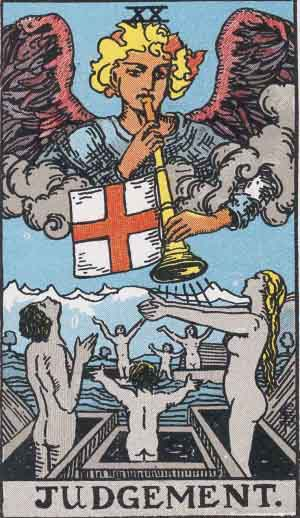
This was before the 2020 election, and it unambiguously predicted that Trump would win. The 20th trump depicts and angel with orange-blond hair blowing a trump with a flag on it -- obviously indicating a certain orange-haired man named Trump who was born on Flag Day.

Well, so far Trump has still not been recognized as the winner of the 2020 election, but I think the hit is still impressive; regardless of who won, the 2020 election was undeniably about Donald Trump, and the 20th trump shows that. It also comments on other aspects of that election. For example, below the angel we see a crown of gray people celebrating. Could these not represent Biden voters, as in the meme?

These gray people are depicted rising from the grave, which is also relevant.

So I think that, despite the failure of my prediction about 2020, it remains true that the trumps of the Rider-Waite deck correlate with their corresponding election years.

There are only 21 trumps, though, so it would appear that there are no more standing prophecies for the rest of the century -- or are there?

Let's go back to the 2000 election. The Fool card is numbered 0 in the Rider-Waite, and it unambiguously calls the election for George W. Bush.


First there's the name of the card: "The Fool." In the running joke about the evil party vs. the stupid party, everyone understands that the Republicans are the stupid party. Bush in particular was portrayed by the media as a likable idiot (as opposed to Al Gore's "smart but wooden" persona), and one of his famous malapropisms even features the word fool.


Then there's the name of the winning candidate: George Walker Bush. The Fool is walking, and is the only depiction of a person walking in the Major Arcana, so there's Walker. He holds a rose, a flower which grows on a bush, so there's Bush. To get George, we have to take into account the astrological correspondences associated with the Fool card. The Golden Dawn, in a system based on the Sepher Yetzirah, assigned the 22 Major Arcana to the 12 zodiac signs, the seven classical "planets," and three of the four classical elements; and the Fool was assigned to Air. Following the discovery of Pluto, though, it became common to replace the three elements with the three "new" planets, and thus the Fool became associated with Uranus. Uranus is not that planet's oldest name, though; when William Herschel discovered it in 1781, he proposed the name Georgium Sidus, "the Georgian Star," in honor of King George III. That's a link to the name George, of course, but it's more than that: Dubya was literally President George III, having been preceded by his father and George Washington.

In my reading for the 2022 midterms, I drew the Fool card twice and tentatively interpreted it as referring to the state of Georgia. I reached this conclusion by browsing a gallery of state flowers and finding the one that most closely resembled the flower held by the Fool: the white Cherokee rose, state flower of Georgia. Only later did I make the Uranus connection -- the Georgian Star -- and then realize that one of the candidates from Georgia was named Herschel Walker. There's that name Walker again, and Herschel is about as explicit a reference to Uranus as you could ask for. Furthermore, Walker was even called "the Georgian star" when he was playing football for the University of Georgia -- whose mascot is a white dog.

At the time of this writing, it is still undecided whether or not Herschel Walker has won his race for the Senate; it was judged too close to call, and a runoff is planned. Anyway, win or lose, there is no denying that Herschel Walker is a key figure in the 2022 election, and that the Fool card fits him just as perfectly as it fit George W. Bush 22 years earlier.

This suggests that the "standing prophecies" continue beyond 2021 -- that after reaching the 21st and last trump we go back to zero and begin again. That would mean -- and this is where it gets ominous -- that the trump corresponding to the next presidential election, in 2024, would be the 2nd -- the High Priestess.


This is the same card I got in my one-card reading for Inauguration Day 2021, and it corresponds precisely what we saw on that day: a woman touching a Bible with her left hand while JB stands in the background.


Note also that the Golden Dawn system of correspondences associates this trump with the Hebrew letter gimel, meaning "camel." The Thoth version of this card -- designed and painted by a woman named Harris -- even includes a picture of a camel.


By the way, see that black crescent on the Thoth card? That even matches the phase of the moon on January 20, 2025 (but not in 2021, when it was a First Quarter, with the right side illuminated).


Can this possibly mean the reelection of Biden and Harris? With fraudulent elections, it certainly can't be ruled out. Or perhaps it will be Harris herself as president, without Slow Joe.

Debbie keeps predicting that we will get a Triumvirate government soon. I believe the Triumvirs she originally proposed were Kamala Harris, Donald Trump, and Jeff Bezos, though recently she's suggesting it may be Barack Obama rather than Harris. I don't really put too much stock in this prediction, but it's interesting to note that Jeff Bezos also has the initials JB. Or what if Obama is replacing Trump, not Harris? Then the Priestess is Kamala, and the pillars represent a black man named Barack and a white man named Jeff.

Or it could be someone entirely different. After all, getting the Fool again in 2022 didn't mean George W. Bush was coming back, just another person who also happened to match that card.

Thursday, November 10, 2022

Election prediction assessment

In my midterm reading, I got the Five of Cups as the overall effect on the GOP. Daily Kos agrees.


For the overall effect on the Senate, I got the Fool -- a card I had already identified with Georgia. At the time of this writing, Georgia has emerged as the key state for the Senate, with a runoff election planned. Assuming the other races go as expected, the result in Georgia will decide whether or not the GOP gets a majority in the Senate.


I identified the Fool with Georgia for two reasons: (1) the white rose he holds suggests Georgia's state flower, the white Cherokee rose, and (2) "this card has been associated with the name George in the past." This was a reference to my 2020 post "Can the deck itself be prophetic?" in which I retrospectively read the Fool card -- numbered 0, and thus corresponding to the '00 election -- as predicting the election of George W. Bush. One of the reasons I gave was this:

The Fool card depicts a man walking. Bush was commonly referred to by his middle initial: W, or “Dubya.” His full name is George Walker Bush.

I would say that's a pretty good omen for Herschel Walker, one of the candidates in the Georgia runoff.


Update: Dude. The "Walker" link is just the beginning.


That's right, the Fool card is traditionally linked to a planet for which the proposed names included "Georgian Planet" and Herschel.

(This also further cements my George W. Bush interpretation of the card. The Fool is Uranus, and the discoverer of Uranus originally wanted to name it after George III. Dubya was America's "George III," the third president of that name after Washington and Bush père.)

Tuesday, November 8, 2022

Hey, Rider-Waite, anything to say about the midterms?

I haven't been following the lead-up to the election and have no particular expectations. I'm just sort of testing my equipment here.

Three States with particularly significant or dramatic results:


Fool: This is a shot in the dark, but I'm going to say this is Georgia. There's a white rose on the card, and Georgia's state flower is the white Cherokee rose. Also, this card has been associated with the name George in the past. Eight of Pentacles: Looks like business as usual, presumably a win for the incumbent. Which doesn't sound very significant or dramatic.

Ace of Cups: Washington, D.C. There's a dove (D) and a cup (C), and there's a big W on the cup. The overall imagery is also connected with washing, and the Latin for "dove" is columba (District of Columbia). I guess California is a possibility, too, since its capital is Sacramento, but overall I'm pretty confident this is Washington. Does anything interesting ever happen in D.C. at midterms? It's so overwhelmingly Democratic that I can't imagine there are ever any surprises. Eight of Swords: Paralysis and blindness. A looong wait for the results. Again, I can't imagine this actually happening in a D.C. local election, so perhaps it refers to the effect on the federal government of the election as a whole.

Hanged Man: Not sure about this one. The gallows forms a big T, so it could be Tennessee or Texas -- more likely the latter, since TX = Tau cross. Just a wild guess. Nine of Swords: A nightmare -- but from whose point of view? Update: I'm kicking myself for not recognizing the Hanged Man as the Oz/Fetterman race. Upside down = antipodes = Australia = Oz, and it's literally a man hanging by a fetter around his ankle.

Overall effect on...

Okay, that's literally a blue wave in the House, and that imagery is echoed in each of the other cards. A major loss for the GOP, and the Dems feeling their oats. Not what any sane person would predict, but then sane people don't base their political predictions on Tarot cards, do they?

And finally, the whole election in a nutshell:

Defiance. Refusal to concede.

What it looks like to me: Massive, absolutely undeniable fraud, handing a big win to the Dems. A general rejection of the legitimacy of the results, leading to paralysis and a crisis in Washington. Perhaps accusations of fraud in the other direction in Georgia, where the Republican incumbent will win. And maybe something shocking in Texas? Don't tell me Beto's going to "win"!

Tuesday, October 4, 2022

The three-by-seven grid and the Sephiroth

I have been working with this layout of the 21 numbered trumps of the Tarot de Marseille.


I arranged the cards in three rows and seven columns for practical reasons. The dimensions of the above image are roughly 3×4, making it convenient to display the whole thing on a computer screen, to print it out on a piece of A4 paper, or to lay the cards out that way on a table. Three columns and seven rows would be a much more awkward 1×4.

Nevertheless, three columns seems more correct conceptually, as it calls to mind the three columns of the Tree of the Sephiroth. Actually, the standard 10-sephirah Tree of Life (absent Da'ath, which presumably corresponds to the Fool) arranges the sephiroth in three columns and seven vertical levels. If we overlay that on our three-by-seven grid, ten of the trumps would be mapped to sephiroth. Ther are four logical ways this could be done: We could start at the Kether level and move down or start at the Malkuth level and move up; and within each level we could go from left to right or from right to left. The most promising mapping starts at the Malkuth level and goes from right to left.


A few of these mappings are obvious "hits." Netzach means "victory," and that is the traditional meaning of the Chariot -- called, in the first known listing of the trumps, Lo carro triumphale, "the chariot of triumph." Yesod, "foundation," is mapped to the Pope. The first pope is supposed to have been St. Peter, of whom Christ said, "upon this rock I will build my church" (Matt. 16:18).

Most of the rest of the mappings are at least understandable and defensible. The first and highest sephirah, from which all the others emanate, is mapped to the Angel, called "Judgment," but representing the love of God. Chokmah, representing direct inspiration, fits well with the bolt from the sun; while Binah, representing reflective wisdom, is well symbolized by the reflected light of the Moon. Geburah, called the "left hand of God" meting out punishment, is the Devil. Tiphareth, "beauty," maps to the beautiful woman subduing a lion, and Hod, "glory," to the Hermit with his blazing lantern. At the gestalt level, the left and right columns correspond to yin/feminine and yang/masculine, as they should.

The only really jarring mapping is between Chesed, "mercy, kindness, benevolence," and Death.

Monday, October 3, 2022

The first row of the three-by-seven grid

In my last post, I discussed this layout of the 21 numbered trumps of the Tarot de Marseille.


In that post, I focused on the second row and suggested that is seven cards represent the Seven Heavenly Virtues: Prudence (the Papess), Faith (the Pope), Justice, Fortitude, Temperance, Hope (the Star), and Charity (the Angel).

The first row also seems to make sense as an orderly progression. The Magician with his wand becomes the Emperor with his scepter. We see this man with crown and scepter again the Chariot, where he directs a wheeled vehicle drawn by two animals -- horses in the classic Tarot de Marseille, but sphinxes (human-animal chimerae) in the deck of Jacques Viéville and those influenced by him. On the next card, the Wheel of Fortune, we see all the same elements: the wheel, the crowned ruler (now a sphinx himself), and the two animals or hybrid creatures -- but the ruler is no longer in control, and his position at the top is no longer stable. The wheel will turn -- there will be a revolution -- and he will fall. The next card, l'Arcane sans nom, shows the aftermath of this: a severed head on the ground, still wearing his crown. After the fall of the individual ruler, the fall of the institution itself: On the next card, a blast from the sun "decapitates" a tower, the top of which resembles a crown, and two young men fall to the ground. The final card in the series seems to show the aftermath of this: the Sun, which destroyed the tower, dominates the scene, and we see the two young men, naked, and behind them a low wall suggesting the ruins of the tower.

Sunday, October 2, 2022

The love of God in the Tarot

If the 21 numbered trumps of the Tarot de Marseille are laid out as below, in seven columns of three, meaningful patterns emerge.


The first thing to notice is that the three virtue cards -- Justice, Strength (originally called Fortitude), and Temperance -- are together in the center of the diagram. Many commentators have pointed out that only three of the four Cardinal Virtues are explicitly included in the Tarot and have tried to associate one of the other trumps (usually the Hermit) with the fourth, Prudence. The Tarot was designed by medieval Christians, though, not by ancient Greeks, and for them there were seven virtues: the four Cardinal Virtues plus the Theological Virtues of Faith, Hope, and Charity. In our table above, the three explicitly named virtues are at the center of a row of seven cards, where they are flanked by the Pope (an obvious symbol of Faith) and the Star (a conventional symbol of Hope). That leaves the Papess and Judgment for the remaining two virtues, Prudence and Charity. The Papess is a good fit for Prudence, since that virtue has sometimes been personified as a crowned woman with a book.


That leaves the Judgment to represent Charity, which is admittedly not an obvious match. Charity, often described as unconditional love, seems the very opposite of judgment; and indeed Din ("judgment") is placed opposite Chesed ("lovingkindess") on the Tree of Life. In fact, though, Judgment is not the trump's original name, and the last judgment is not what it portrays. The earliest name of the 10th trump is The Angel, and the scene it depicts is the resurrection of the dead at the last trump, as described by St. Paul in two of his epistles. Neither passage makes any reference to a judgment.

Here is 1 Corinthians 15:51-57.

Behold, I shew you a mystery; We shall not all sleep, but we shall all be changed, in a moment, in the twinkling of an eye, at the last trump: for the trumpet shall sound, and the dead shall be raised incorruptible, and we shall be changed.

For this corruptible must put on incorruption, and this mortal must put on immortality. So when this corruptible shall have put on incorruption, and this mortal shall have put on immortality, then shall be brought to pass the saying that is written, Death is swallowed up in victory.

O death, where is thy sting? O grave, where is thy victory? The sting of death is sin; and the strength of sin is the law. But thanks be to God, which giveth us the victory through our Lord Jesus Christ.

This is not a judgment at all. On the contrary, Paul implies that resurrection is possible because the Law, which makes us guilty sinners worthy of death, has been superseded.

The second "trump" passage is 1 Thessalonians 4:13-18.

But I would not have you to be ignorant, brethren, concerning them which are asleep, that ye sorrow not, even as others which have no hope. For if we believe that Jesus died and rose again, even so them also which sleep in Jesus will God bring with him. For this we say unto you by the word of the Lord, that we which are alive and remain unto the coming of the Lord shall not prevent them which are asleep.

For the Lord himself shall descend from heaven with a shout, with the voice of the archangel, and with the trump of God: and the dead in Christ shall rise first: Then we which are alive and remain shall be caught up together with them in the clouds, to meet the Lord in the air: and so shall we ever be with the Lord.

Wherefore comfort one another with these words.

Again, nothing about judgment -- just a comforting promise that we will be reunited with our dead and with the Lord.

The resurrection of the dead is actually the perfect expression of "charity," or the love of God -- the noun form, in the original Greek, of the verb used in John 3:16-17.

For God so loved the world, that he gave his only begotten Son, that whosoever believeth in him should not perish, but have everlasting life. For God sent not his Son into the world to condemn the world; but that the world through him might be saved.

Resurrection is love. "We know that we have passed from death unto life, because we love the brethren. He that loveth not his brother abideth in death" (1 Jn. 3:14). What we do not love, we are content to let perish. The resurrection is the love of God finding even in such corrupt and imperfect being as ourselves something worthy of being raised to immortality. Those who trust in the love of God can say with David, "my flesh also shall rest in hope, for thou wilt not [i.e. art unwilling to] leave my soul in hell" (Ps. 16:9-10).

St. Paul's discussion of the resurrection in 1 Cor. 15:41-42 also contains something potentially relevant to the part of the Tarot deck we are discussing:

There is one glory of the sun, and another glory of the moon, and another glory of the stars: for one star differeth from another star in glory. So also is the resurrection of the dead. It is sown in corruption; it is raised in incorruption.

The sequence Star, Moon, Sun is invariant in all known historical orderings of the trumps, from Ferrara to Bologna to Marseille -- a fact that has puzzled commentators because it seems at odds with Medieval cosmology. The lowest of the heavenly spheres was that of the Moon, followed by the Inferior Planets, the Sun, the Superior Planets, and finally the Fixed Stars. Placing the Moon between the Stars and the Sun makes no sense -- and yet that is what we find in 1 Corinthians, apparently because Paul is ordering the heavenly bodies not by their location in the cosmos but by their brightness or "glory" as seen from Earth.

Star, Moon, Sun, Judgment, World. If we assume this is a continuation of Paul's scheme, then the Judgment and the World should represent two even higher degrees of glory, brighter than the Sun. The card called the World evolved from representations of the Throne of God, so that checks out. The Judgment, then, is a luminary brighter than the Sun and nigh unto the Throne of God. Astronomically, this would be Kolob, but its deeper meaning can only be "the love of God, which sheddeth itself abroad in the hearts of the children of men; . . . the most desirable above all things" (1 Ne. 11:22). Some old decks make it the highest trump of all, higher even than the World.

If this identification of the seven virtues is correct, their order in the Tarot is: Prudence, Faith, Justice, Fortitude, Temperance, Hope, Charity. This is consistent with Cicero's ordering of the four cardinal virtues in De Inventione and Paul's ordering of the theological virtues in 1 Cor. 13.

Tuesday, September 20, 2022

The Ace of Cups combines baptismal and Eucharistic imagery

In my 2020 post "The Ace of Cups: A brief overview of its development," I concluded that the Ace of Cups, particularly in its Marseille incarnation, is a "chalice with a cover serving as a monstrance" -- a monstrance, or ostensorium, being an object used to display the Host. I was baffled, though, by the fact that, despite the very clear Eucharistic imagery, the chalice is always shown flowing with water, never with wine or blood. I also failed to see any Eucharistic meaning in the Pierpont Morgan-Bergamo Visconti-Sforza card, which seemed to show a fountain; and I thought that interpreting the bird ornament on the PMB fountain as the dove of the Holy Ghost was an innovation of Waite's.

Now, having followed some leads from Michael J. Hurst's 2007 post "The Ace of Cups: Christian Content in Tarot," I want to revisit some of these questions.

First, the PMB card turns out to be more Eucharistic than I had imagined. Consider this German woodcut of the late 15th century, called by the National Gallery, "Allegory of the Eucharist."


Note the structure of the central object: A pillar rises up from the center of a hexagonal basin; two spouts on the sides of the pillar pour out liquid; and at the top is a dove. The Eucharistic intention is obvious, since it is a fountain of blood with what are apparently Hosts floating in it. (Hurst provides a black-and-white version of this picture and suggests that the two streams of liquid represent the water and blood that flowed from the pierced side of the Crucified; in color, though, we can see that it is all blood.)

Now compare the image above with the Ace of Cups of the PMB Visconti-Sforza deck.


This is an extremely close match. The main differences are that the basin now has a stem and base like a goblet, and that the liquid is water rather than blood.

So why is it water? Why do all these cards have a design that shouts this is the blood of Christ, only to show it as water instead?

In my 202 post, I noted how similar the Marseille Ace of Cups is to this late 15th-century Spanish monstrance.


One important difference, though, is that the monstrance has no bowl -- it lacks the very part of the Ace of Cups that makes it a cup! That's why I conjectured that it must be some sort of combined chalice-and-monstrance, even though I scoured the Net in vain for images of any such object. (I did find combined chalice-monstrances, but not with a design at all similar to that seen on the Ace.) And the question still remains as to why water -- blue, definitely not wine or blood -- should be shown flowing out of the object.

Well, it turns out some old baptismal fonts look a lot like the Ace of Cups -- a large basin on a stem and base, with an ornate "Gothic" cover.


So it appears that the Ace of Cups combines the imagery of chalice, monstrance, and font. The blood/wine/water ambiguity is not entirely unbiblical, either. Several passages present the blood of Christ as something we might drink or wash in; Christ "bled" water as well as blood on the cross; and of course there is the famous miracle at Cana, where water was turned into wine. Jesus connected drinking from a cup with being baptized when he said, "Are you able to drink the cup I drink or to be baptized with the baptism I am baptized with?" (Mark 10:38). In Gethsemane he referred to his coming passion and death as a cup to drink from, and Paul later said baptism was a symbol of Christ's death -- we are "buried with him in baptism" (Col. 2:12). Mormons in particular will appreciate the connection, since the Mormon Eucharist uses water instead of wine and is said to be a renewal of one's baptismal covenants.

Waite's card also, I think, contains both baptismal and Eucharistic imagery.


As I mentioned in my earlier post, a dove flying over a chalice with a Host in its beak is very common Eucharistic iconography. On Waite's card, though, the dove is flying straight down as if it is going to dip the Host into the water. Since the Host is the body of Christ, this corresponds to the baptism of Jesus -- which was also the occasion on which the Holy Ghost descended in the form of a dove. Waite has five streams of water where we would expect four, but if water and blood are interchangeable, they could be a reference to the Five Wounds of the Crucified.

The dove flying over water also appears in the story of Noah, and it is perhaps significant in the present context that after the Flood, Noah invented wine and got drunk. In 1 Peter, baptism is connected with Noah's ark, in which "eight souls were saved by water -- the like figure whereunto even baptism doth also now save us" (3:20-21).

This biblical connection between baptism and the number eight is probably why Mormons baptize at the age of eight, and why so many baptismal fonts are octagonal. It is curious, then, that the German woodcut and the Visconti and Marseille Aces all show a hexagonal structure. Hexagonal baptismal fonts are extremely uncommon, and chalices are round, so where does this come from? Well, according to this post at the Liturgical Arts Journal, the very oldest extant monstrance, dated to 1286, is hexagonal and is an extremely close match for the Marseille Ace.


So I think we have to say that the Ace of Cups combines elements of three different sacred objects: the font, the chalice, and the monstrance.

Synchronistic postscript: After writing the above, I ran an image search on holy grail medieval drawing to see if the Holy Grail was every depicted as an object similar to the Ace of Cups. The search was useless -- most of the results were modern drawings and showed a simple chalice -- but one result got my attention because it appeared at first glance to show a chalice with a Gothic cover. What it actually turned out to be, though, was a combined image of the Grail, a castle, and my friend the owl.

Between a dog and a wolf

In all Marseille-style decks of which I am aware, the Moon card feature two dogs or jackals: a light blue one on the left, and a pink or buff one on the right. (See "The red and blue jackals.") Aside from the color and a slight difference in size (with the larger, blue dog perhaps corresponding to Sirius in Canis Major), the two animals are the same.

This color scheme, universal among Marseille decks, was jettisoned by the early Marseille-influenced esoteric Tarots, beginning with Oswald Wirth's 1889 deck. Wirth's canines are black and white rather than red and blue, but they still both appear to be dogs.


The 1909 Rider-Waite deck uses yet another color scheme, but also introduces more significant differences between the two animals. One has the floppy ears of a domestic dog, while the other has the erect ears and bushy tail of a wolf. Waite confirms this in The Pictorial Key to the Tarot, writing, "The dog and wolf are the fears of the natural mind in the presence of that place of exit, when there is only reflected light to guide it."


This dog and wolf theme is also used -- and rather more competently executed artistically -- in the 1929 Knapp-Hall deck. One animal is clearly a wolf, while the other is a domestic dog complete with a collar.


Mary K. Greer connects this dog-and-wolf theme with the French idiom entre chien et loup, meaning "at twilight." This is an expression of Latin origin (inter canem et lupum) -- with twilight being thought of as "between" the domain of the diurnal dog and that of the nocturnal wolf, or perhaps between the time when people put out their dogs to keep watch and the time the wolves begin to come out. French etymology dictionaries, though, give a different explanation: that it refers to the dim light in which it is difficult to distinguish a dog from a wolf ("l'heure où la lumière décline car on confond alors facilement entre chien et loup"), and it is apparently in this sense that most modern Francophones understand the idiom. (Inter canem et lupum is also sometimes used in the sense of "between a rock and a hard place," but the obvious contrast between man's best friend and his deadly enemy makes it hard to see this as anything but an ignorant corruption.)

Anyway, this Latin and French idiom never made it into English, so it is curious that the French and French-Swiss decks have two dogs, while the English and American decks introduce the entre chien et loup imagery. However, there are precursors in the French literature (with which Waite, having translated much of it, was quite familiar). Wirth's Le tarot des imagiers du moyen-âge (1927) describes the two animals as "the big black dog" and "the little white dog," with no hint that either of them might be a wolf. However, when the opening paragraph of his description of the Moon card is read with the idiom in mind, it is hard to deny its relevance.

In order to display the splendours of the sky, the Night plunges the earth into darkness, for the things above are not revealed to our sight except to the detriment of those below. However we aspire to relate the celestial to the terrestrial by a simultaneous contemplation, which is made possible when the Moon spreads her pale light. The body which is close to the stars without subduing their brightness completely, only half lights up the objects bathed in her uncertain and borrowed light. The Moon does not allow us to distinguish colours; everything her rays strike upon she tinges with a silvery grey or with vague bluish shades, leaving the opaque darkness of the shadows of night to continue.

Papus did not produce a deck of his own. In his Le Tarot des Bohémiens (1889), the section on each trump has two illustration: the 1889 Wirth card and the traditional Tarot de Marseille. Although both of these show two dogs, Papus refers in his commentary to a dog and a wolf.

In the middle, a dog and a wolf howl at the moon, a crayfish comes out of the water and crawls in the midst of these animals. The entry of the Spirit into Matter is a fall all the greater as everything conspires to increase it. The "servile spirits" (dog), the "ferocious larvae" (wolf) and the "crawling elementals" (crayfish) are there who watch for the fall of the soul into matter to try to oppress it even more.

Wirth hints at the idiomatic meaning of entre chien et loup but identifies both animals as dogs. Papus identifies them as a dog and a wolf, despite using cards that portray them both as dogs, and yet his commentary on the card says nothing about twilight of the difficulty of distinguishing things in half-light.

One suspects that the "missing link," or rather the "common ancestor," is Wirth's first Tarot book, Le Livre de Thot comprenant les 22 arcanes du Tarot (1889), but unfortunately I have not yet been able to track down a copy to check. My hypothesis is that this earlier book explicitly refers to the dog and the wolf; that his later book, with its emphasis on astrology, dropped the wolf references in favor of Canes Major and Minor; but that traces of the author's earlier emphasis remain in the introductory paragraph. If I ever do manage to get my hands on Le Livre de Thot, it will be interesting to see if this speculative reconstruction is borne out.

A darker view of the Three of Pentacles

Since June 9, 2024, I have seen the Three of Pentacles as being primarily a dark or negative card, even though Waite's Pictorial Key to ...