Showing posts with label Rider-Waite. Show all posts

Sunday, February 22, 2026

A darker view of the Three of Pentacles


Since June 9, 2024, I have seen the Three of Pentacles as being primarily a dark or negative card, even though Waite's Pictorial Key to the Tarot assigns it a positive meaning. Here I want to explore this darker view of the card, incorporating some comments by Bill Wright on my post "All the pebbles I have seen."

⁂

1. Working in the dark to build a church from secret plans

Bill notes that on the card, "men are working on/ in a Cathedral or Church," and

The Three of Pentacles shows these men working literally in the dark - the men are juxtaposed against a completely black background and environment while they discuss their plans.

He further notes that the man on the left, wearing an apron and holding a maul, is a stonemason, thus suggesting Freemasonry and the Book of Mormon theme of "secret combinations." Working in darkness, secret plans, and (somewhat surprisingly) church-building are all portrayed in negative terms in the Book of Mormon. Many passages could be cited here, but one part of the book that hits on all of these themes is 2 Ne. 26-28, part of Nephi's long discourse that makes up two-thirds of that book:

And the Gentiles are lifted up in the pride of their eyes, and have stumbled, because of the greatness of their stumbling block, that they have built up many churches; . . . . And there are many churches built up which cause envyings, and strifes, and malice. And there are also secret combinations, even as in times of old, according to the combinations of the devil, for he is the founder of all these things; yea, the founder of murder, and works of darkness . . . . For behold, my beloved brethren, I say unto you that the Lord God worketh not in darkness (2 Ne. 26:22-23).

And wo unto them that seek deep to hide their counsel from the Lord! And their works are in the dark; and they say: Who seeth us, and who knoweth us? (2 Ne. 27:27, quoting Isa. 29:15)

For it shall come to pass in that day that the churches which are built up, and not unto the Lord, when the one shall say unto the other: Behold, I, I am the Lord's; and the others shall say: I, I am the Lord's; and thus shall every one say that hath built up churches, and not unto the Lord (2 Ne. 28:3).

Yea, and there shall be many which shall . . . seek deep to hide their counsels from the Lord; and their works shall be in the dark (2 Ne. 28:9).

Coming back to the Masonic angle -- and we must remember that A. E. Waite, the designer of this card, was himself a Mason and wrote several books on the subject -- it is perhaps significant that there are three men on the card and that the only Masonic implement detected is the Maul. In the legend of Hiram Abiff, which is part of a Master Mason's initiation, Hiram was murdered in the Temple of Solomon (which he had designed) by three ruffians, lesser Masons intent on extracting from him the secrets of a Master, and the weapon that dealt him the death blow was a Maul (sometimes called a Gavel). One Masonic pamphlet I've read (I can't seem to find it online) says that the Maul is the only Masonic implement to have no explicit moral lesson attached to it, and the writer proposes that, as the weapon with which Master Hiram was murdered, it should serve to remind us of the sanctity of life. In other words, the implement Waite chose to depict on this card is one which in Masonry has no other symbolic meaning than murder -- specifically, secret murder committed by members of an oath-bound fraternity.

⁂

The Three of Pentacles and the Devil

Nephi, quoted above, refers to "the combinations of the devil, . . . the founder of murder, and works of darkness." It is interesting to note, then, certain iconographic connections between the Three of Pentacles and the Devil card.

Besides the 14 cards of the suit of Pentacles, two of the Major Arcana also feature pentacles or pentagrams. A quick glance at all 16 cards incorporating this symbol shows that two of them stand out as different:


As you can see, almost all of the pentacles on these cards follow the same black-on-yellow color scheme. The only exceptions are the Three of Pentacles and the Devil:


Once this has been noticed, other correspondences between these two cards suggest themselves. The Devil's number is 15, and a trio of five-pointed stars represents the same number. In the Golden Dawn system, the Devil represents Capricorn, and the Three of Pentacles is the second decan of the same sign. Both cards have a black background, with gray and tan as the other dominant colors. Both show two figures standing on the floor and a third standing on a raised surface. This third figure raises the left hand ("left" from our point of view) and in the right holds an implement with its head angled downward.

On the Three of Pentacles, the implement is the Maul. On the Devil, it is a torch. However, John Opsopaus's Pythagorean Tarot offers a different interpretation of the Devil, portraying him as Hephaestus or Vulcan and putting in his hand what may look an awful lot like Dr. Evil's spaceship but is in fact "a large hammer or mallet."


I have connected the hammer-wielding mason on the Three of Pentacles with the murder of Hiram Abiff, as told in the Master Mason's degree. The password of the Master's degree is Tubal Cain. In the Bible, Tubal-cain is the first smith, "an instructer of every artificer in brass and iron" (Gen. 4:22), and a fanciful folk-etymology derives Vulcan from his name. Given the, uh, spaceship-like shape of the hammer on Opsopaus's card, it is significant that Masons typically portray the secret name Tubal Cain via the rebus "two-ball cane."


The name Cain is of course closely associated with secret combinations. The Jaredite secret combinations, we are told, "had been handed down even from Cain" (Ether 8:15), and Cain took a title that many have seen as a very thinly veiled reference to the rank of Master Mason:

And Cain said: Truly I am Mahan, the master of this great secret, that I may murder and get gain. Wherefore Cain was called Master Mahan, and he gloried in his wickedness (Moses 5:31).

Cain was succeeded in this title by Lamech, and thus perhaps by Lamech's son Tubal-cain (Moses 5:49). 

⁂

The Three and Nine of Pentacles

One February 13, 2026, I drew a single card from my Rider-Waite deck, put it face-down on the table in front of me, and, as is my usual practice, attempted to perceive it psychically before turning it face-up. I "saw" three pentacles arranged in a triangle and a figure in a red and yellow robe, so I very confidently predicted that it was the Three of Pentacles. When I turned it over, though, it was the Nine.


This false prediction made me notice parallels between these two cards that I'd never noticed before. On the right side of the Nine of Pentacles, we have three pentacles arranged in a triangle, much like those on the Three. On the left, we have this same triangular arragement -- this time oriented exactly like that on the Three -- repeated twice. As it happens, these are also the only two cards in the deck to show someone wearing a yellow garment with a pattern of red marks on it. The grapes on the Nine, together with the woman's curly hair, also suggest the female figure from the Devil card.

As I contemplated the card, I thought about the falcon. This is a bird known for its excellent eyesight, but on the card its eyes are covered with a hood, which made me think of the line "the seers hath he covered." As it happens, this line from Isaiah is quoted in the very section of 2 Nephi I cited above in reference to building churches and working in the dark.

For behold, the Lord hath poured out upon you the spirit of deep sleep. For behold, ye have closed your eyes, and ye have rejected the prophets; and your rulers, and the seers hath he covered because of your iniquity (2 Ne. 27:5).

I've always seen the Nine of Pentacles as a very positive card, and I still think that is its usual meaning. But every card has many meanings, and one of its meanings does seem to tie it to the Three.

Tuesday, September 20, 2022

The Ace of Cups combines baptismal and Eucharistic imagery

In my 2020 post "The Ace of Cups: A brief overview of its development," I concluded that the Ace of Cups, particularly in its Marseille incarnation, is a "chalice with a cover serving as a monstrance" -- a monstrance, or ostensorium, being an object used to display the Host. I was baffled, though, by the fact that, despite the very clear Eucharistic imagery, the chalice is always shown flowing with water, never with wine or blood. I also failed to see any Eucharistic meaning in the Pierpont Morgan-Bergamo Visconti-Sforza card, which seemed to show a fountain; and I thought that interpreting the bird ornament on the PMB fountain as the dove of the Holy Ghost was an innovation of Waite's.

Now, having followed some leads from Michael J. Hurst's 2007 post "The Ace of Cups: Christian Content in Tarot," I want to revisit some of these questions.

First, the PMB card turns out to be more Eucharistic than I had imagined. Consider this German woodcut of the late 15th century, called by the National Gallery, "Allegory of the Eucharist."


Note the structure of the central object: A pillar rises up from the center of a hexagonal basin; two spouts on the sides of the pillar pour out liquid; and at the top is a dove. The Eucharistic intention is obvious, since it is a fountain of blood with what are apparently Hosts floating in it. (Hurst provides a black-and-white version of this picture and suggests that the two streams of liquid represent the water and blood that flowed from the pierced side of the Crucified; in color, though, we can see that it is all blood.)

Now compare the image above with the Ace of Cups of the PMB Visconti-Sforza deck.


This is an extremely close match. The main differences are that the basin now has a stem and base like a goblet, and that the liquid is water rather than blood.

So why is it water? Why do all these cards have a design that shouts this is the blood of Christ, only to show it as water instead?

In my 202 post, I noted how similar the Marseille Ace of Cups is to this late 15th-century Spanish monstrance.


One important difference, though, is that the monstrance has no bowl -- it lacks the very part of the Ace of Cups that makes it a cup! That's why I conjectured that it must be some sort of combined chalice-and-monstrance, even though I scoured the Net in vain for images of any such object. (I did find combined chalice-monstrances, but not with a design at all similar to that seen on the Ace.) And the question still remains as to why water -- blue, definitely not wine or blood -- should be shown flowing out of the object.

Well, it turns out some old baptismal fonts look a lot like the Ace of Cups -- a large basin on a stem and base, with an ornate "Gothic" cover.


So it appears that the Ace of Cups combines the imagery of chalice, monstrance, and font. The blood/wine/water ambiguity is not entirely unbiblical, either. Several passages present the blood of Christ as something we might drink or wash in; Christ "bled" water as well as blood on the cross; and of course there is the famous miracle at Cana, where water was turned into wine. Jesus connected drinking from a cup with being baptized when he said, "Are you able to drink the cup I drink or to be baptized with the baptism I am baptized with?" (Mark 10:38). In Gethsemane he referred to his coming passion and death as a cup to drink from, and Paul later said baptism was a symbol of Christ's death -- we are "buried with him in baptism" (Col. 2:12). Mormons in particular will appreciate the connection, since the Mormon Eucharist uses water instead of wine and is said to be a renewal of one's baptismal covenants.

Waite's card also, I think, contains both baptismal and Eucharistic imagery.


As I mentioned in my earlier post, a dove flying over a chalice with a Host in its beak is very common Eucharistic iconography. On Waite's card, though, the dove is flying straight down as if it is going to dip the Host into the water. Since the Host is the body of Christ, this corresponds to the baptism of Jesus -- which was also the occasion on which the Holy Ghost descended in the form of a dove. Waite has five streams of water where we would expect four, but if water and blood are interchangeable, they could be a reference to the Five Wounds of the Crucified.

The dove flying over water also appears in the story of Noah, and it is perhaps significant in the present context that after the Flood, Noah invented wine and got drunk. In 1 Peter, baptism is connected with Noah's ark, in which "eight souls were saved by water -- the like figure whereunto even baptism doth also now save us" (3:20-21).

This biblical connection between baptism and the number eight is probably why Mormons baptize at the age of eight, and why so many baptismal fonts are octagonal. It is curious, then, that the German woodcut and the Visconti and Marseille Aces all show a hexagonal structure. Hexagonal baptismal fonts are extremely uncommon, and chalices are round, so where does this come from? Well, according to this post at the Liturgical Arts Journal, the very oldest extant monstrance, dated to 1286, is hexagonal and is an extremely close match for the Marseille Ace.


So I think we have to say that the Ace of Cups combines elements of three different sacred objects: the font, the chalice, and the monstrance.

Synchronistic postscript: After writing the above, I ran an image search on holy grail medieval drawing to see if the Holy Grail was every depicted as an object similar to the Ace of Cups. The search was useless -- most of the results were modern drawings and showed a simple chalice -- but one result got my attention because it appeared at first glance to show a chalice with a Gothic cover. What it actually turned out to be, though, was a combined image of the Grail, a castle, and my friend the owl.

Between a dog and a wolf

In all Marseille-style decks of which I am aware, the Moon card feature two dogs or jackals: a light blue one on the left, and a pink or buff one on the right. (See "The red and blue jackals.") Aside from the color and a slight difference in size (with the larger, blue dog perhaps corresponding to Sirius in Canis Major), the two animals are the same.

This color scheme, universal among Marseille decks, was jettisoned by the early Marseille-influenced esoteric Tarots, beginning with Oswald Wirth's 1889 deck. Wirth's canines are black and white rather than red and blue, but they still both appear to be dogs.


The 1909 Rider-Waite deck uses yet another color scheme, but also introduces more significant differences between the two animals. One has the floppy ears of a domestic dog, while the other has the erect ears and bushy tail of a wolf. Waite confirms this in The Pictorial Key to the Tarot, writing, "The dog and wolf are the fears of the natural mind in the presence of that place of exit, when there is only reflected light to guide it."


This dog and wolf theme is also used -- and rather more competently executed artistically -- in the 1929 Knapp-Hall deck. One animal is clearly a wolf, while the other is a domestic dog complete with a collar.


Mary K. Greer connects this dog-and-wolf theme with the French idiom entre chien et loup, meaning "at twilight." This is an expression of Latin origin (inter canem et lupum) -- with twilight being thought of as "between" the domain of the diurnal dog and that of the nocturnal wolf, or perhaps between the time when people put out their dogs to keep watch and the time the wolves begin to come out. French etymology dictionaries, though, give a different explanation: that it refers to the dim light in which it is difficult to distinguish a dog from a wolf ("l'heure où la lumière décline car on confond alors facilement entre chien et loup"), and it is apparently in this sense that most modern Francophones understand the idiom. (Inter canem et lupum is also sometimes used in the sense of "between a rock and a hard place," but the obvious contrast between man's best friend and his deadly enemy makes it hard to see this as anything but an ignorant corruption.)

Anyway, this Latin and French idiom never made it into English, so it is curious that the French and French-Swiss decks have two dogs, while the English and American decks introduce the entre chien et loup imagery. However, there are precursors in the French literature (with which Waite, having translated much of it, was quite familiar). Wirth's Le tarot des imagiers du moyen-âge (1927) describes the two animals as "the big black dog" and "the little white dog," with no hint that either of them might be a wolf. However, when the opening paragraph of his description of the Moon card is read with the idiom in mind, it is hard to deny its relevance.

In order to display the splendours of the sky, the Night plunges the earth into darkness, for the things above are not revealed to our sight except to the detriment of those below. However we aspire to relate the celestial to the terrestrial by a simultaneous contemplation, which is made possible when the Moon spreads her pale light. The body which is close to the stars without subduing their brightness completely, only half lights up the objects bathed in her uncertain and borrowed light. The Moon does not allow us to distinguish colours; everything her rays strike upon she tinges with a silvery grey or with vague bluish shades, leaving the opaque darkness of the shadows of night to continue.

Papus did not produce a deck of his own. In his Le Tarot des Bohémiens (1889), the section on each trump has two illustration: the 1889 Wirth card and the traditional Tarot de Marseille. Although both of these show two dogs, Papus refers in his commentary to a dog and a wolf.

In the middle, a dog and a wolf howl at the moon, a crayfish comes out of the water and crawls in the midst of these animals. The entry of the Spirit into Matter is a fall all the greater as everything conspires to increase it. The "servile spirits" (dog), the "ferocious larvae" (wolf) and the "crawling elementals" (crayfish) are there who watch for the fall of the soul into matter to try to oppress it even more.

Wirth hints at the idiomatic meaning of entre chien et loup but identifies both animals as dogs. Papus identifies them as a dog and a wolf, despite using cards that portray them both as dogs, and yet his commentary on the card says nothing about twilight of the difficulty of distinguishing things in half-light.

One suspects that the "missing link," or rather the "common ancestor," is Wirth's first Tarot book, Le Livre de Thot comprenant les 22 arcanes du Tarot (1889), but unfortunately I have not yet been able to track down a copy to check. My hypothesis is that this earlier book explicitly refers to the dog and the wolf; that his later book, with its emphasis on astrology, dropped the wolf references in favor of Canes Major and Minor; but that traces of the author's earlier emphasis remain in the introductory paragraph. If I ever do manage to get my hands on Le Livre de Thot, it will be interesting to see if this speculative reconstruction is borne out.

Thursday, March 17, 2022

Temperance, the Hermit, and the hourglass

As I pointed out in last year's post "First thoughts on Temperance," the image on the Temperance card -- liquid being poured from one vessel to another -- is conceptually similar to an hourglass, and that an hourglass has actually been used elsewhere as a symbol of that virtue.

Detail from Ambrogio Lorenzetti,
Allegory of Good Government (1338)

Lorenzetti's painting is in fact the earliest known depiction of an hourglass -- and it is captioned Tenperantia (cf. the spelling Tenperance used in most old Marseille decks).

If we look at the hourglass as a symbol of time itself (tempus), the narrow neck in the center represents the present moment. The lower chamber, full of sand which has already passed through that neck, corresponds to the past; and the upper chamber is the future.

Now compare this to the Tarot image of Temperance.

Pierre Madenié (1709)

The angel of Temperance is pouring water from the vessel in her left hand (our right) into the one in her right (our left). Since the original image is of pouring water into wine to dilute it, the upper vessel contains water, and the lower one contains wine. The upper vessel corresponds to the upper chamber of the hourglass, which has the form of an inverted triangle -- the alchemical symbol for Water. The upright triangle of the lower chamber is the alchemical symbol for Fire (with which wine is associated). If we add horizontal lines through the triangles, we have the alchemical symbols for Earth and Air. Just as the angel of Temperance is pouring Water into wine (Fire), an hourglass pours sand (Earth) into an "empty" chamber (Air).


Notice that the grains of sand in the upper chamber of an hourglass move toward the center, while those in the lower chamber move away from the center. In the Aristotelian schema (from On Generation and Corruption), centripetal motion is associated with the Cold elements of Water and Earth, and centrifugal motion with the Hot elements of Fire and Air.

Fire and Air are masculine elements, while Water and Earth are feminine. In the hourglass, and in the vessels of Temperance, we have a sort of reverse-insemination symbolism, with the masculine vessel passively receiving material from the feminine. In the hourglass, this inversion is explicit: the only reason an hourglass works at all is that it artificially inverts the natural arrangement, putting Earth above Air; the motion of the sand is gravity's gradual rectification of this unnatural state of affairs. Notice that both in Lorenzetti's painting and on the Tarot card, the receptive vessel is held in the masculine right hand; and on the card, the other vessel (I can't think of an appropriate antonym for receptive) is held in the feminine left hand.

If the upper vessel represents the future and the lower vessel the past, the main difference between the hourglass and the Temperance image is the present. In the hourglass, as in our common conception of time, the present is where the future and the past meet, and it approximates a dimensionless geometric point. On the Temperance card, the two vessels are separated, and the present -- no longer dimensionless -- corresponds to the stream of water flowing between them. Temperance. The present has been expanded from a point to a line. Our ordinary perception of time is as a line bisected by a point present, but occasionally (mostly in the dreaming state), we have access to the higher-dimensional perspective of meta-time: a time plane bisected by a linear present -- a meta-present which embraces the entire timeline of ordinary experience. (I have posted about this many times; search my blogs for the name Dunne.) In my 2018 post "As the heavens are higher than the earth," I interpret the "higher" perspective referred to by Isaiah as being dimensionally higher.

One sense in which the heavens are higher than the earth is in their higher dimensionality. Strictly speaking, of course, the earth is a spheroid and is just as three-dimensional as the heavens, but the earth as experienced by man is essentially a two-dimensional surface, which is why it is often convenient to represent it with two-dimensional maps. The heavens, in contrast are fully and irreducibly three-dimensional, such that no two-dimensional map would be a close enough approximation to be of any use.

Human thoughts and ways tend to be limited to three spatial dimensions, with the fourth dimension experienced as “time.” God, who is eternal rather than temporal, can be conceptualized as thinking and working (at minimum) “one dimension up” — using the fifth dimension as time, which enables him to see our whole four-dimensional continuum as “present.”

But just as the earth is not truly two-dimensional, human thought and experience is not truly limited to the “temporal” (meaning the perspective from which the fourth dimension is “time”). Just as we can sometimes look down from a mountaintop or an airplane, using the third dimension to get a wider-than-usual view of the two-dimensional surface on which we live and perhaps an inkling of the perspective of “the heavens,” so can we sometimes attain a fleeting glimpse of the higher-dimensional (“eternal”) perspective of God.

These "fleeting glimpses" of the perspective from which the present is not a point but a line -- can they not be symbolized by an hourglass with the two chambers drawn apart, a flowing stream taking the place of the point-like neck? And don't the angel's wings and eye-like headdress also suggest this "higher perspective"?

⁂

If hourglass imagery is implicit in Temperance, it was explicit in the card now known as the Hermit but originally called il Gobbo, il Vecchio, or il Tempo (the Hunchback, the Old Man, or Time). Like the figure in the Lorenzetti painting, the Old Man carried an hourglass, holding the lower chamber in his right hand.

Visconti-Sforza (mid 15th century)

When what presumably began as a copying error transformed the hourglass into a lantern, this character developed into the Hermit of the Tarot de Marseille and his close cousin, the Capuchin of the Tarot de Besançon. (Even some decks that call him the Hermit make an exception to their standard eight-color palette to give him the characteristic brown robe of a Capuchin friar. Historically, the Capuchin style of dress was a deliberate homage to that of the Camaldolese Hermits.)

Pierre Madenié (1709), Johan Jerger (1801)

The Rider-Waite card generally follows this model, deviating from it as described by Waite in The Pictorial Key to the Tarot.

The variation from the conventional models in this card is only that the lamp is not enveloped partially in the mantle of its bearer, who blends the idea of the Ancient of Days with the Light of the World. It is a star which shines in the lantern. I have said that this is a card of attainment, and to extend this conception the figure is seen holding up his beacon on an eminence. Therefore the Hermit is not, as Court de Gebelin explained, a wise man in search of truth and justice; nor is he, as a later explanation proposes, an especial example of experience. His beacon intimates that "where I am, you also may be."

Waite writes the Hermit's number not as VIIII but as IX -- the Greek initials of Jesus Christ -- a decision perhaps not unrelated to his identification of the Hermit with the title "Light of the World" (John 8:12) and with the saying "where I am, there ye may be also" (John 14:3).

The most interesting feature of the Rider-Waite Hermit in the present context, though, is that "it is a star which shines in the lantern" -- specifically, a six-pointed star, or hexagram.


The hexagram in the lantern is interesting for two reasons. First, it reintroduces the hourglass's symbolism of the two opposing elemental triangles.


As shown above, Temperance and the Hermit take the hourglass symbolism in opposite directions. In Temperance, the two chambers of the glass are separated and moved farther apart, expanding the point that connects them (the punctal present of object time) into a stream (the linear present of meta-time). In the Hermit, the two chambers overlap and interpenetrate.

What this could mean in terms of time is hard to make out. While the Temperance image features a linear present -- an extensive region which is neither past nor present -- the hexagram has instead a large two-dimensional region which is both past and present whatever that could mean! So far I have not been able to find any coherent symbolism in this.

The other reason the Rider-Waite star-in-the-lantern image is interesting is that it is a link to the Star card, which in turn is obviously closely related to Temperance.


Marseille decks invariably have eight-pointed stars, and Waite follows that tradition, but in Switzerland the number of points was somewhat variable. Besançon decks often have five-pointed stars, and one deck (only one that I know of) actually has hexagrams like the one in the lantern of Waite's Hermit.

François Héri, Solothurn 1730

I find the Star to be one of the very most enigmatic Tarot trumps, the origin of its iconography a mystery. I suppose it must have come from depictions of the constellation Aquarius -- often shown pouring out two water jugs in Medieval zodiacs -- but in the context of the Tarot deck the similarity to the Temperance image must be intentional and must have some meaning. I have connected Temperance with the Hermit by way of the shared hourglass imagery, and Waite's Hermit completes the triangle by connecting the Hermit with the Star.

I am not yet sure what to make of these connections, but I think in the future I will have to contemplate these three trumps together.

Sunday, January 9, 2022

Can an Indian be president?

I first got interested in the Tarot around the turn of the century. At around the same time, I discovered the legendary net.kook Gene Ray (1927-2015) -- self-proclaimed Greatest Thinker and Wisest Human, discovered of Nature's Harmonic Simultaneous 4-Day Time Cube, and author of a sprawling, hilariously offensive website that expounds on this incoherent theory-of-everything whilst belittling the reader.

Well, naturally, this led to the game of taking Tarot cards and replacing the titles with Gene Ray quotes that would give the picture a completely different meaning. I no longer have any of the original images, but here's a quick reconstruction of one that I remember.


Eventually, this developed into the project of designing a whole Cube Spirit deck (Majors only), modifying both the images and the titles to illustrate Time Cube principles. The Nuclear Waste lady, became a student wearing an MIT sweatshirt and jeans; an evil educator was added in the background, looking on in approval; and the number of stars in the sky was reduced to four (because "You can't have less than four, you can't have more than four").

The Empress card was renamed the Indian President, inspired by this Gene Ray quote.


Ray was clearly talking about American Indians here, and there was no indication that the Indian president might be a woman. However, when I looked at the Rider-Waite Empress card, her microphone-like scepter and floral-print gown made me think of a photo I had seen of Indira Gandhi -- who I guess was technically an Indian Prime Minister, but whatever.


I no longer have any of these cards, but I remember that this one was closely based on the Indira Gandhi photo but modified so as to suggest an American president delivering the State of the Union address. The president -- looking pretty much exactly like Indira Gandhi, but with a forehead dot added for extra Indian-ness -- stood at a podium, flanked by two generic clapping politicans, with a huge American flag hanging in the background.

In short, I had portrayed the Empress as a female Indian-American president of the United States -- and specifically patterned her after Indira Gandhi, daughter of Kamala Nehru.

Look back at that screenshot of Ray's "Indian president" question and notice that the immediate context refers to race-mixing ("racial slop") and to the US becoming a "black nation." Kamala Harris is mixed-race and generally presents herself not as an Indian-American but as "black."

I haven't thought of the Cube Spirit Tarot for ages, but a few months ago, in August 2021, I posted "Copper Queen," in which I connected Kamala Harris with the Empress card for completely unrelated reasons. That post was focused on the slightly modified Empress card that appears in the Grateful Dead "Ripple" video, in which the Empress holds a yin-yang symbol in one hand. In that post, I included a screenshot of the Wikipedia article for "Copper" and noted that it featured both a Venus symbol (such as appears on the Empress's shield) and a yin-yang symbol.


Now take a closer look at the paisley-floral motif on Indira Gandhi's costume.

Friday, January 7, 2022

More on the U.S. presidency in 2022

What fascinates me about Tarot reading is not that what the cards say always comes true, but rather the simple, astonishing fact that they always do say something. Whatever question I put to them, they always address it. It is not the accuracy that impresses so much as the sheer responsiveness. In theory, it can all be dismissed as coincidence and apophenia; in practice, this becomes harder and harder to do with a straight face.

Sometimes I think people like me shouldn't be allowed to play with Tarot cards. You take a tool designed to turn synchronicity up to 11 and put it in the hands of someone like me, and -- well, isn't that a bit reckless?

*

My January 4 Reading for 2022 involved drawing "before" and "after" cards showing how various people and things would change or develop over the course of the coming year. Included were "before" and "after" cards for Joe Biden and Kamala Harris.

On January 6, wanting further clarification, I drew "before" and "after" cards for the presidency as a whole. Below are the two cards from the January 6 reading, with the corresponding Biden and Harris cards from the January 4 reading below.


The Two of Cups, for the start of 2022, clearly matches up with the Biden and Harris cards from the earlier reading.  It has precisely the same layout as the Devil card: a woman on the left, a man on the right, and a central non-human figure looming in the background. The man on the Two of Cups is wearing practically the same tunic as the Page of Wands, confirming that he is Biden, the woman is Harris, and the lion/devil is the shadowy power behind the throne.

At the end of 2022, the Queen of Cups shows a woman alone on the throne, dressed similarly to the woman on the Two of Cups (blue and white clothes, laurel wreath). Strength shows a woman with a lion. In my earlier reading, I was unsure as to which of the figures on the Devil card this lion represented, the man or the devil. In the Two of Cups, though, the lion clearly corresponds to the devil. It appears, then, that the year begins with Biden and Harris sharing nominal power but in fact controlled by a hidden "devil." By the end of the year, Biden is out of the picture and Harris is in control, in partnership with the "devil."

Leaving aside the Five of Wands, in which the five figures are not readily identifiable as individuals, we have the following mappings:
  • the Devil = the lion-headed caduceus on the Two of Cups = the lion on Strength
  • the Page of Wands = the Devil's male captive = the man on the Two of Cups = Joe Biden
  • the Queen of Cups = the Devil's female captive = the woman on the Two of Cups = the woman on Strength = Kamala Harris
Let us look at each of these in turn.

*

The Devil

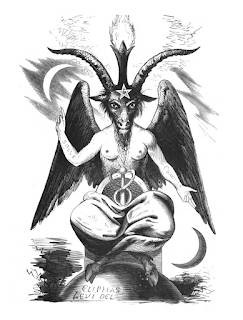
Looking at the Two of Cups in isolation, I would never have thought to connect it with the Devil. Once the connection has been made, though, another image immediately comes to mind as the "missing link" between the two: Éliphas Lévi's famous drawing of "Baphomet" or "the Sabbatic Goat," first published in 1856 in his Dogme et Rituel de la Haute Magie, and since coopted by self-styled Satanists. 

There is no question that Waite was very extensively influenced by Lévi, and his Devil is very clearly patterned after Lévi's Goat. We see the horns, the pentagram, the torch, the position of the arms, etc. -- all rather different from the way the Devil is typically portrayed in the Marseille tradition. However, Lévi's drawing also features feathered wings and a caduceus -- which appear not on Waite's Devil card but on his Two of Cups.

There is no lion's head on Lévi's Baphomet, though. For that, we need to look at another image: the myterious "Leontocephaline" (lion-headed) figure associated with Mithraism.


Notice the lion's head, the feathered wings, and the caduceus -- all the elements that feature in the Two of Cups. The exact identity of this figure is a matter of speculation and scholarly debate, but it has become conventional to refer to it as Arimanius -- that is to say, Ahriman, the "devil" of Zoroastrianism, whose name would later be used by Rudolf Steiner (and later still by my own circle of Romantic Christians) to refer to the materialistic, bureaucratic, "lawful evil" aspect of the demonic.

Are the two people on the Two of Cups drinking a toast to the devil, then? Ah, but the cups combined with the caduceus give an added meaning.


The cup and serpent is the Bowl of Hygieia, symbol of pharmacy. Here we have two cups and two serpents -- but the serpents are combined to form a caduceus, symbol of commerce. Isn't such an unholy combination precisely what we have in mind when we say "Big Pharma"? And isn't Big Pharma one of the primary manifestations of Ahriman in the modern world?

In this context, another detail of Lévi's Baphomet image becomes interesting: The monster's raised right arm is labeled "Solve," and his lowered left arm is labeled "Coagula." These have an alchemical meaning in their original context, but in the context of Big Pharma in 2022, it is impossible not to notice the resonance with a particular medical intervention, being pushed relentlessly by the Ahrimanic establishment, which is supposed to "solve" a supposed crisis but is actually causing a real crisis having to do with hematological "coagulation."

In addition to whatever Mithraic meaning it may have, the winged lion also appears in the Bible (Daniel 7) as a symbol of Nebuchadnezzar's Babylon. The "guardian of peace and security" statue that was briefly installed at the UN headquarters at the end of last year was connected by many with this beast, as well as with the Beast of Revelation -- which also represents "Babylon," meaning Rome.


Babylon, Rome, 666, the UN, Big Pharma -- Ahriman. The devil figure on these cards represents not some particular person who is the real power behind the throne, but rather the Ahrimanic System which is the power behind all thrones -- at least "till the thrones are cast down" (Dan. 7:9).

*

The Page of Wands (Biden)

There is little to add to my discussion of Biden in "Reading for 2022." However, the addition of Baphomet to the mix suggests a possible interpretation of the Devil setting fire to the Biden figure's tail with the torch he holds in his left hand. The corresponding arm on Lévi's Baphomet is labeled coagula -- could this be a hint that Biden could be removed from action by pharmacologically induced thrombosis? That would be a very plausibly deniable way of offing him wouldn't it -- Alec Baldwinning him next time he does a fake peck photo op? The effect needn't be immediate, either. The Devil card shows his tail being lit as if it were a fuse, which makes me think of these lines from the They Might Be Giants song "Hide Away Folk Family."

Tippy-toe to the front door, Mother,
'Cause there's a guy with a long, long fuse
And the one thing you can't hide is all the fear you feel inside
As the fuse is spelling out these words

Chorus:
Hide away folk family
Or else someone's gonna get ya (Someone's gonna get ya)
Someone's gonna get ya
Hide away folk family
Better hide away
Better hide away

Tippy-toe to the flat-bed, Father,
Because they're pouring out our gasoline
And sadly the cross-eyed bear's been put to sleep behind the stairs
And his shoes are laced with irony

Chorus

Hello. This is Lesley Down with the daily home astrology report.
Taurus: Contemplate domestic turmoil.
Aquarius: Abandon hope for future plans.

I'm not sure if the Taurus and Aquarius references mean anything, but it's interesting to note that Inauguration Day is often the day the Sun enters Aquarius.

*

The Queen of Cups (Harris)

Looking at all of the cards we are considering, we find Harris represented four times: twice as a woman with a cup, once as a woman with grapes growing from her tail, and once as a woman with a lion. This theme of cups and grapes reminds me that in Aleister Crowley's version of the Strength card (renamed Lust; in order to maintain his cred as the Wickedest Man in the World, Crowley renamed all three virtue trumps), the woman is portrayed as the biblical Whore of Babylon and is holding a cup.


Crowley himself characterizes this cup as "the Holy Grail burned with love and death," but in the Bible it is "a golden cup in her hand full of abominations and filthiness of her fornication" (Rev. 17:17), and "the inhabitants of the earth have been made drunk with the wine of her fornication" (Rev. 17:2). 

The identification (divinatory, not literal!) is clinched by the way this character is introduced in Revelation: "I will shew unto thee the judgment of the great whore that sitteth upon many waters" (Rev. 17:1). If you look at the Queen of Cups, you will see that she, too, sits upon many waters, her throne being on a tiny island or promontory, with water all around. Note also that Biden and Harris are often disparagingly referred to as "Joe and the Hoe" -- the latter title being nothing but a dialect version of the word used in Revelation.

Oh, and did I mention that "Crowley's" cards were actually painted by a woman named Harris?

Tuesday, December 21, 2021

The Three of Swords and the Immaculate Heart

Waite, influenced by the Sola Busca, illustrated his Three of Swords with a heart being pierced by three swords.

Sola Busca (late 15th century), Rider-Waite (1909)

The Gospel of Luke records a man named Simeon saying to Mary, shortly after the birth of Jesus, "Yea, a sword shall pierce through thy own soul also, that the thoughts of many hearts may be revealed" (Luke 2:35). It is for this reason that the Immaculate Heart of Mary is often portrayed with a sword through it.

Sometimes, though, the Immaculate Heart is shown with seven swords through it, representing the Seven Sorrows of Mary.

These Seven Sorrows are:

  1. the prophecy of Simeon already mentioned
  2. the flight into Egypt
  3. the loss of the child Jesus at the Temple
  4. meeting Jesus on the road to Calvary
  5. the Crucifixion
  6. Jesus' body being taken down from the cross
  7. the burial of Jesus

The number seven is obviously somewhat contrived here -- four of the Sorrows are basically part of the same event, the Crucifixion, and their number could easily be arbitrarily increased or decreased (cf. the 14 Stations of the Cross). Nevertheless, it has become traditional, and our interpretation of the Tarot card should respect that.

Note that Simeon's prophecy of a sword piercing Mary's soul is taken as a reference to these Seven Sorrows -- but that one of those sorrows is that prophecy itself! Thus, Simeon prophesied six sorrows, and that prophecy of six sorrows is itself the seventh (or first) sorrow. Likewise, the Three of Swords shows a heart with six wounds (for each sword makes an entry and an exit wound), and the whole image itself represents the remaining sorrow, the prophecy of Simeon.

Monday, November 22, 2021

The Emperor's orb

Visconti-Sforza (c. 1451, restored), Pierre Madenié (1709),
Oswald Wirth (1889, revised 1926), Rider-Waite (1910)

Emperor cards typically feature the Reichsadler, the scepter, and the globus cruciger. How exactly these are incorporated into the card varies widely from deck to deck.

The Reichsadler -- a black eagle displayed on a gold field -- was the emblem of the Holy Roman Emperors prior to the 15th century, when it was replaced by the double-headed eagle. Bembo's Visconti-Sforza card puts this emblem on a vaguely shield-shaped headdress which does not, so far as I know, resemble anything worn by any historical emperor, and which almost looks more like a mitre than a crown. The Marseille tradition (as typified by Madenié, even though his cards were actually made in Dijon), puts it on a shield -- the traditional "coat of arms." Wirth combines this shield and the throne into a cubic stone marked with the Reichsadler. Waite eliminates the eagle entirely, replacing it with the Aries imagery demanded by his astrological schema.

Bembo's scepter is a simple rod with no ornament at the top. The Marseille tradition tops it with the globus cruciger; Wirth, with a stylized fleur-de-lis. Waite makes the scepter resemble both the Egyptian ankh and the Mesopotamian rod-and-ring.

The emblem I want to focus on here, though, is the globus cruciger, or orb.


Looking at this close-up of the original Visconti-Sforza card (top left), we can see that the "restored" version I used above (because it is clearer) has been restored incorrectly. The orb is topped with a cross pattée atop a short, narrow pedestal, and the orb itself is marked with zigzag ("indented") lines, suggestive of a cracking egg. These form a circle around the equator and a semicircle connected the equator to the north pole, where the cross is.

Where Bembo had put the orb in the Emperor's left hand, the Marseille tradition (top right) puts it at the end of his scepter, thus strengthening the axis mundi symbolism of the latter by making the axis of an actual globe. Having no orb to hold, the Emperor's left hand appears to be holding his own belt. The orb has the same general form as Bembo's, but instead of indented lines, we have have bands of a different color. In many Marseille cards, including Pierre Madenié's, there is also a second, much smaller globus cruciger at the top of the Emperor's crown.

Wirth puts the orb back in the Emperor's hand and gives it the same general form as the Marseille version, but it is idiosyncratic in two ways. First, the orb itself is green, in contrast to the otherwise universal use of gold, both for Tarot cards and for real-world crown jewels. The second oddity is the diminutive size of the cross, also something that has no analogue of which I am aware either in pre-Wirth Tarot or in the real world. The whole point of the globus cruciger symbolism is Christ's dominion over the world, and so the cross is typically about as large as the orb itself.

Orbs with a much smaller cross, though rare to nonexistent among crown jewels, do sometimes appear in paintings of Christ himself in his role as salvator mundi. In such paintings, the orb is also a direct representation of the world rather than of a royal accoutrement, and as such it is often transparent or blue in color rather than gold. The closest parallel I can find in art to Wirth's orb is this Brazilian icon of Christ as a child. Perhaps a bit more digging (this one is straight off Wikipedia) would turn up some similar image from Wirth's neck of the woods.


Another significant feature of Wirth's orb is where it is held relative to the Emperor's body, so that the center of the globe -- the omphalos -- coincides with the presumed location of the Emperor's own navel. Mormons may make of this, and of the Emperor's protruding right knee, what they will.

Waite returns the orb to its traditional gold color but eliminates the cross entirely. While some salvator mundi images (such as Leonardo's) do omit the cross and feature a simple globe, Waite's is not a simple globe, either. Where the cross should be, there is a little nub, almost as if it were the pedestal for a cross without the cross itself. What it really reminds me of, actually, is a gold version of a stereotypical cartoon bomb, the little nub being where the fuse would be attached.


The other thing it reminds me of is the Liahona, described as "a round ball of curious workmanship; and it was of fine brass. And within the ball were two spindles; and the one pointed the way whither we should go into the wilderness." (1 Nephi 16:10). Despite the clear statement that there were two spindles within the ball, artists' depictions of the Liahona invariably show a single protrusion extending out from the top of the ball.

Here is a detail Arnold Friberg's classic Liahona painting, painted in the 1950s and included in many editions of the Book of Mormon since then.


And here is a modern version of the same subject, which has appeared before on this blog. Although the style is very different from Friberg's, the basic design of the Liahona -- a gold-colored ball with a little protrusion at the top -- remains invariable.


It has become common among Mormon intellectuals to contrast the Liahona with another Book of Mormon image, the Iron Rod, a metaphor first used by Richard D. Poll in his 1967 Dialogue article "What the Church Means to People Like Me" (pdf). "Iron Rod" Mormons are more dogmatic and emphasize the authority of the Scriptures and Church leaders, while "Liahona" Mormons are more questing/questioning and emphasize personal inspiration and the guidance of the Holy Ghost. In practice, Liahona and Iron Rod connote "liberal" and "conserative," respectively.

The term Iron Rod comes from Lehi's dream in 1 Nephi 8, where the "rod of iron" is a sort of handrail to which people hold in order not to stray from the path as they pass through the mists of darkness. In Revelation, though, the "rod of iron" seems to be Christ's scepter: "to rule all nations with a rod of iron" (12:15). This imagery, in turn, comes from Psalm 2, where the rod of iron is a weapon with which to smash the heathen to bits, but in Revelation it is consistently used "to rule" (2:27, 12:5, 19:15).

If the iron rod is a scepter, then the Emperor (in most non-Marseille decks) can be seen as holding the Liahona in his left hand and the Iron Rod in his right. This fits with the symbolism just discussed, where the Liahona and Iron Rod symbolize the Mormon "left" and "right." It should also be understood in connection with my earlier discussion of the Emperor's Urim and Thummim, in which the Emperor's right side is associated with the square and his left with the compass. In Mormon use, the square symbolized exactness and honor in keeping covenenats -- clearly an "Iron Rod" concept -- while the compass reminds us of the "Liahona" principle that all truth (not only "official Church doctrine") may be circumscribed into one great whole.

Another thing the gold orb on the Rider-Waite card resembles is a Christmas-tree ornament -- and Waite's Emperor, with his red robes and long, white beard, bears more than a passing resemblance to Father Christmas.

Finally, no discussion of a monarch holding a golden ball would be complete without a nod to the Frog King from the Brothers Grimm. (Irrelevant coincidence: Will Smith's first Golden Globe nomination was for "The Froschprinz of Bel-Air.")


This is clearly an image of Kek, the ancient Egyptian god of chaos whose cult enjoyed such a surprising revival a few years back. (See "The Truth About Pepe The Frog And The Cult of Kek." Apparently Kek has not been entirely forgotten; just after the Kyle Rittenhouse verdict, Anonymous Conservative posted a reminded that "A giant frog statue stands in Rittenhouse Square.") Like many Egyptian deities, Kek is often depicted with a was-scepter and ankh; on the Waite card, the scepter and ankh are combined.

The golden ball also suggests the golden apple of Eris -- Kek's predecessor as deity of a chaos-based parody religion.

Friday, October 15, 2021

Arcanum 19 and Revelation 19


An arcanum is something hidden or concealed (etymologically, something shut up in an ark). Revelation has the opposite meaning. Is it a coincidence that Revelation is the 22nd epistle of the New Testament and comprises 22 chapters?

I didn't have this in mind when I first made the connection between Arcanum 19 (The Sun) and Revelation 19. Rather, I was thinking about the rider on a white horse that appears on the Rider-Waite version of the card. I had previously identified it with the first of the Four Horsemen of the Apocalypse:

And I saw, and behold a white horse: and he that sat on him had a bow; and a crown was given unto him: and he went forth conquering, and to conquer (Rev. 6:2).

I had connected this with the global coup of 2020 -- a connection which is even clearer if you read the Vulgate.

Et vidi: et ecce equus albus, et qui sedebat super illum, habebat arcum, et data est ei corona, et exivit vincens ut vinceret.

The horseman of the Rider-Waite, unlike the Jacques Viéville figure on which he is based, wears a "crown" of flowers. (No bow appears on the Tarot card, but that weapon is so closely associated with far-darting Apollo, god of the Sun, and with Robin Hood, that we may consider it to be implicitly present.)

There is another rider on a white horse in Revelation, though: the one in Chapter 19.

And I saw heaven opened, and behold a white horse; and he that sat upon him was called Faithful and True, and in righteousness he doth judge and make war. His eyes were as a flame of fire, and on his head were many crowns; and he had a name written, that no man knew, but he himself (Rev. 19:11-12).

The crown on the Rider-Waite figure is actually "many crowns," being made up of several golden circlets.

And he was clothed with a vesture dipped in blood: and his name is called The Word of God (Rev. 19:13).

The Rider-Waite figure is not clothed, but the blood-red flag he bears calls to mind the "vesture dipped in blood."

And the armies which were in heaven followed him upon white horses, clothed in fine linen, white and clean. And out of his mouth goeth a sharp sword, that with it he should smite the nations: and he shall rule them with a rod of iron: and he treadeth the winepress of the fierceness and wrath of Almighty God. And he hath on his vesture and on his thigh a name written, King Of Kings, And Lord Of Lords (Rev. 19:14-16).

Like the other rider on a white horse, he goes forth conquering, and to conquer.

And I saw an angel standing in the sun; and he cried with a loud voice, saying to all the fowls that fly in the midst of heaven, "Come and gather yourselves together unto the supper of the great God; That ye may eat the flesh of kings, and the flesh of captains, and the flesh of mighty men, and the flesh of horses, and of them that sit on them, and the flesh of all men, both free and bond, both small and great" (Rev. 19:17-18).

Immediately after this, we have a reference to the Sun and an implied reference to crows.

A darker view of the Three of Pentacles

Since June 9, 2024, I have seen the Three of Pentacles as being primarily a dark or negative card, even though Waite's Pictorial Key to ...