Showing posts with label Aleister Crowley. Show all posts

Monday, January 10, 2022

A seriously weird coincidence with my Biden/Harris readings

There's an old, long-defunct podcast called Mother. Years ago I listened to one or two of the episodes about Whitley Strieber. Just recently I suddenly decided to methodically listen to all the episodes on YouTube, starting with the oldest. In the early hours of January 10, I was listening to an episode called "June 20 2015 Trio," and one of the three anonymous participants told a story about how, during a time when there had been a lot of Gray activity in his home, he had thrice found Tarot cards laid out on his living room table, apparently by them. As I listened, I fell to wondering if I could somehow get the Grays to lay out Tarot cards for me (this despite the fact that I've seen no real signs of Gray activity in Taiwan), and the thought occurred to me that perhaps my recent practice of drawing cards virtually, via a computer-mediated truly random number generator, might be making it more inconvenient for them (or other such intelligences) to intervene.

The speaker went on to relate the details of the three Tarot spreads. The first time was the Hermit, the Chariot, and the Tower from the Rider-Waite deck -- but it was the second incident that really got my attention

A: The other instance of this was the Prince of Wands from the Crowley deck, the Lovers, and -- and, uh, Strength.

B: The Prince of Wands is not Major Arcana.

A: No, it's Minor Arcana. So that deviates from Strieber's emphasis on the Major Arcana. There was the Prince of Wands, there was Strength -- which in the Crowley deck is Lust -- and there was -- I can't remember -- I don't -- well, I don't want to sidetrack the discussion too much, so, I mean, you can make of that what you will -- maybe the Priestess.

I have very little interest in, sympathy with, or knowledge of the Crowley deck, and cards from that deck have appeared on this blog only twice. The first time was in an old post that was just a gallery of Magician cards from dozens of different decks, including Crowley's. The second time was in "More on the U.S. presidency in 2022," posted less than three days before listening to the above material -- and the card was Strength/Lust.

Notice how the podcaster refers to "the Crowley deck" rather than using its proper name, the Thoth Tarot. He also twice calls the card Strength before mentioning parenthetically that Crowley actually renamed it Lust. Now compare that to my own language in introducing the same card: "Aleister Crowley's version of the Strength card (renamed Lust; in order to maintain his cred as the Wickedest Man in the World, Crowley renamed all three virtue trumps)." I, too, do not mention the Thoth Tarot by name, and I call the card Strength first, mentioning Crowley's renaming only parenthetically. Note that the podcaster also mentions the Prince of Wands and the Priestess -- names which are also distinctive to the Thoth Tarot and differ from the more traditional titles -- but the only name change he mentions is Strength to Lust.

In my post, I had connected Strength/Lust with Kamala Harris. While I was in the process of writing this present post, I read a comment by Debbie on one of my other posts, saying, "Doesn't the name Kamala in Sanskrit mean :'lotus' or 'pale red'???" I knew that Kamala meant "lotus" and was an epithet of Lakshmi, but I didn't know it meant "pale red," so this comment led me to look up the etymology again, and I found this:

Kamala (कमल) is a Sanskrit technical term translating to the color “lotus” or “lotus-flower”, but can also refer to “pale-red”, “rose-coloured” etc. and in a different context can also refer to “desirous”, “lustful” etc. It is used throughout Ayurvedic literature such as the Suśrutasaṃhita or the Carakasaṃhita.

Together with Strength/Lust, the podcaster mentioned the Prince of Wands and a third card which he first identified as the Lovers, then said he couldn't remember, and finally said might have been the Priestess. My own "Reading for 2022" had identified Harris with Strength and Biden with the Page of Wands. There is no Page of Wands in the Crowley deck; instead of the usual court-card scheme (King, Queen, Knight, Page), Crowley's courts consist of Knight, Queen, Prince, and Princess. It is the Princess that is most often considered to correspond to the Page in other decks, but a female Princess can hardly represent a male figure like Biden -- so if I wanted to "duplicate" my Page of Wands reading using the Crowley deck, the Prince of Wands would be the nearest equivalent.

Recall that in my own readings, one of the cards for the presidency showed a man and woman with a lion's head, and one of the cards for Harris showed a woman with a lion.


In a singularly appropriate twist, it turns out that the Prince of Wands -- nearest Crowley equivalent to one of the cards I drew for Biden -- shows a man with a lion.


As for the other cards mentioned, Crowley's Lovers shows an interracial marriage, which syncs with Harris in a broad way (she has an Indian mother, a Jamaican mulatto father, and a Jewish husband), but it was the Priestess that really blew my mind.

In my 2020 "Inauguration Day Reading," I drew the Rider-Waite High Priestess card, which seemed to show Harris's swearing in -- a woman with her left hand on the Bible, with "JB" (Joe Biden) standing in the background.


In that post, I mentioned that the Golden Dawn associated the High Priestess with the Hebrew letter gimel, a letter which is often said to represent a camel (suggesting Kamala).

In my "Reading for 2022," I also identified Harris with one of the figures on the Rider-Waite Devil card: a woman with a bunch of grapes growing from her tail.


So imagine my surprise when I looked up Crowley's Priestess card and found that it features this little detail.


That's right, among the clutter in the foreground of the card there is a camel next to a bunch of grapes! Waite and others may have thought of this trump as corresponding to gimel and thus to the camel, but who actually explicitly painted a camel on the card? Who? I emphasize once again that, though we call it the "Crowley deck," both the concept (Crowley had originally wanted to do a traditional Marseille-style deck) and the artwork itself were actually the work of a woman named Harris -- Frieda Harris, who incidentally moved to India shortly before her death.

⁂

I end with an irrelevant anecdote, for no other reason than that the story about Grays leaving out Tarot cards made me think of it.

One morning, somewhere in the 2007-2009 range (based on where I was living at the time), I got up, came downstairs, and found a big chunk of white styrofoam sitting in the exact center of the dining room table. It was about the size of a hen and was ragged around the edges, as if it had been torn from a much larger piece.

There were only two people living in that apartment: me and my wife, who suffers from such an extreme phobia of styrofoam that it would essentially have been physically impossible for her to have put it there herself. And I didn't do it. We kept our door locked all the time, and no one else had a key. So . . .

Friday, January 7, 2022

More on the U.S. presidency in 2022

What fascinates me about Tarot reading is not that what the cards say always comes true, but rather the simple, astonishing fact that they always do say something. Whatever question I put to them, they always address it. It is not the accuracy that impresses so much as the sheer responsiveness. In theory, it can all be dismissed as coincidence and apophenia; in practice, this becomes harder and harder to do with a straight face.

Sometimes I think people like me shouldn't be allowed to play with Tarot cards. You take a tool designed to turn synchronicity up to 11 and put it in the hands of someone like me, and -- well, isn't that a bit reckless?

*

My January 4 Reading for 2022 involved drawing "before" and "after" cards showing how various people and things would change or develop over the course of the coming year. Included were "before" and "after" cards for Joe Biden and Kamala Harris.

On January 6, wanting further clarification, I drew "before" and "after" cards for the presidency as a whole. Below are the two cards from the January 6 reading, with the corresponding Biden and Harris cards from the January 4 reading below.


The Two of Cups, for the start of 2022, clearly matches up with the Biden and Harris cards from the earlier reading.  It has precisely the same layout as the Devil card: a woman on the left, a man on the right, and a central non-human figure looming in the background. The man on the Two of Cups is wearing practically the same tunic as the Page of Wands, confirming that he is Biden, the woman is Harris, and the lion/devil is the shadowy power behind the throne.

At the end of 2022, the Queen of Cups shows a woman alone on the throne, dressed similarly to the woman on the Two of Cups (blue and white clothes, laurel wreath). Strength shows a woman with a lion. In my earlier reading, I was unsure as to which of the figures on the Devil card this lion represented, the man or the devil. In the Two of Cups, though, the lion clearly corresponds to the devil. It appears, then, that the year begins with Biden and Harris sharing nominal power but in fact controlled by a hidden "devil." By the end of the year, Biden is out of the picture and Harris is in control, in partnership with the "devil."

Leaving aside the Five of Wands, in which the five figures are not readily identifiable as individuals, we have the following mappings:
  • the Devil = the lion-headed caduceus on the Two of Cups = the lion on Strength
  • the Page of Wands = the Devil's male captive = the man on the Two of Cups = Joe Biden
  • the Queen of Cups = the Devil's female captive = the woman on the Two of Cups = the woman on Strength = Kamala Harris
Let us look at each of these in turn.

*

The Devil

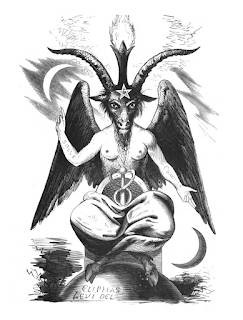
Looking at the Two of Cups in isolation, I would never have thought to connect it with the Devil. Once the connection has been made, though, another image immediately comes to mind as the "missing link" between the two: Éliphas Lévi's famous drawing of "Baphomet" or "the Sabbatic Goat," first published in 1856 in his Dogme et Rituel de la Haute Magie, and since coopted by self-styled Satanists. 

There is no question that Waite was very extensively influenced by Lévi, and his Devil is very clearly patterned after Lévi's Goat. We see the horns, the pentagram, the torch, the position of the arms, etc. -- all rather different from the way the Devil is typically portrayed in the Marseille tradition. However, Lévi's drawing also features feathered wings and a caduceus -- which appear not on Waite's Devil card but on his Two of Cups.

There is no lion's head on Lévi's Baphomet, though. For that, we need to look at another image: the myterious "Leontocephaline" (lion-headed) figure associated with Mithraism.


Notice the lion's head, the feathered wings, and the caduceus -- all the elements that feature in the Two of Cups. The exact identity of this figure is a matter of speculation and scholarly debate, but it has become conventional to refer to it as Arimanius -- that is to say, Ahriman, the "devil" of Zoroastrianism, whose name would later be used by Rudolf Steiner (and later still by my own circle of Romantic Christians) to refer to the materialistic, bureaucratic, "lawful evil" aspect of the demonic.

Are the two people on the Two of Cups drinking a toast to the devil, then? Ah, but the cups combined with the caduceus give an added meaning.


The cup and serpent is the Bowl of Hygieia, symbol of pharmacy. Here we have two cups and two serpents -- but the serpents are combined to form a caduceus, symbol of commerce. Isn't such an unholy combination precisely what we have in mind when we say "Big Pharma"? And isn't Big Pharma one of the primary manifestations of Ahriman in the modern world?

In this context, another detail of Lévi's Baphomet image becomes interesting: The monster's raised right arm is labeled "Solve," and his lowered left arm is labeled "Coagula." These have an alchemical meaning in their original context, but in the context of Big Pharma in 2022, it is impossible not to notice the resonance with a particular medical intervention, being pushed relentlessly by the Ahrimanic establishment, which is supposed to "solve" a supposed crisis but is actually causing a real crisis having to do with hematological "coagulation."

In addition to whatever Mithraic meaning it may have, the winged lion also appears in the Bible (Daniel 7) as a symbol of Nebuchadnezzar's Babylon. The "guardian of peace and security" statue that was briefly installed at the UN headquarters at the end of last year was connected by many with this beast, as well as with the Beast of Revelation -- which also represents "Babylon," meaning Rome.


Babylon, Rome, 666, the UN, Big Pharma -- Ahriman. The devil figure on these cards represents not some particular person who is the real power behind the throne, but rather the Ahrimanic System which is the power behind all thrones -- at least "till the thrones are cast down" (Dan. 7:9).

*

The Page of Wands (Biden)

There is little to add to my discussion of Biden in "Reading for 2022." However, the addition of Baphomet to the mix suggests a possible interpretation of the Devil setting fire to the Biden figure's tail with the torch he holds in his left hand. The corresponding arm on Lévi's Baphomet is labeled coagula -- could this be a hint that Biden could be removed from action by pharmacologically induced thrombosis? That would be a very plausibly deniable way of offing him wouldn't it -- Alec Baldwinning him next time he does a fake peck photo op? The effect needn't be immediate, either. The Devil card shows his tail being lit as if it were a fuse, which makes me think of these lines from the They Might Be Giants song "Hide Away Folk Family."

Tippy-toe to the front door, Mother,
'Cause there's a guy with a long, long fuse
And the one thing you can't hide is all the fear you feel inside
As the fuse is spelling out these words

Chorus:
Hide away folk family
Or else someone's gonna get ya (Someone's gonna get ya)
Someone's gonna get ya
Hide away folk family
Better hide away
Better hide away

Tippy-toe to the flat-bed, Father,
Because they're pouring out our gasoline
And sadly the cross-eyed bear's been put to sleep behind the stairs
And his shoes are laced with irony

Chorus

Hello. This is Lesley Down with the daily home astrology report.
Taurus: Contemplate domestic turmoil.
Aquarius: Abandon hope for future plans.

I'm not sure if the Taurus and Aquarius references mean anything, but it's interesting to note that Inauguration Day is often the day the Sun enters Aquarius.

*

The Queen of Cups (Harris)

Looking at all of the cards we are considering, we find Harris represented four times: twice as a woman with a cup, once as a woman with grapes growing from her tail, and once as a woman with a lion. This theme of cups and grapes reminds me that in Aleister Crowley's version of the Strength card (renamed Lust; in order to maintain his cred as the Wickedest Man in the World, Crowley renamed all three virtue trumps), the woman is portrayed as the biblical Whore of Babylon and is holding a cup.


Crowley himself characterizes this cup as "the Holy Grail burned with love and death," but in the Bible it is "a golden cup in her hand full of abominations and filthiness of her fornication" (Rev. 17:17), and "the inhabitants of the earth have been made drunk with the wine of her fornication" (Rev. 17:2). 

The identification (divinatory, not literal!) is clinched by the way this character is introduced in Revelation: "I will shew unto thee the judgment of the great whore that sitteth upon many waters" (Rev. 17:1). If you look at the Queen of Cups, you will see that she, too, sits upon many waters, her throne being on a tiny island or promontory, with water all around. Note also that Biden and Harris are often disparagingly referred to as "Joe and the Hoe" -- the latter title being nothing but a dialect version of the word used in Revelation.

Oh, and did I mention that "Crowley's" cards were actually painted by a woman named Harris?

Tuesday, November 19, 2019

A gallery of early or otherwise historically important Magician cards

This is primarily for my own future reference, but I post it here because others may find it helpful as well. These are the highest-quality images I have been able to find for each of the cards. They are in something approximating chronological order, keeping in mind that most of the dates are estimates.

I am indebted to Andy's Playing Cards for providing innumerable leads, and to Tarot of Marseilles Heritage for many of the images of cards from that tradition. If I've missed anything important, please inform me in the comments.

(Note: The image of the Oswald Wirth card I had originally posted was incorrect. I replaced it with the correct one on November 23, 2019. The "restored" Jean Dodal card was replaced with the original on November 25, 2019.)

Visconti-Sforza (Milan, 1451)
Ercole I d'Este (Ferrara, 1473)
The Cary Sheet (Milan, 1550)
Jacques Viéville (Paris, 1650)
Jean Noblet (Paris, 1650)
Tarot de Paris (Paris, 1650)
Mitelli's Tarocchini (Bologna, 1664)

Jean Dodal (Lyon, 1710)


Pierre Madenié (Dijon, 1709)
Jean-Pierre Payen (Avignon, 1713)
François Héri (Solothurn, 1718)
Minchiate Etruria (Florence, 1725)
François Chosson (Marseille, 1736)
Jean-Baptiste Madenié (Dijon, 1739)
François Tourcaty (Marseille, 1745)
Rochus Schär (Mümlisvil, 1750)
Claude Burdel (Fribourg, 1751)
Nicolas Conver (Marseille, 1760)
Ignaz Krebs (Fribourg, 1780)
Jacques Rochias (Neuchâtel, 1782)
Grand Etteilla (Paris, 1788)
Minchiate al Leone (Florence, 1790)
Arnoux & Amphoux (Marseille, 1793)
Bernardin Suzanne (Marseille, 1839)
Oswald With (Paris, 1899)
Lequart "Arnoult 1748" (Paris, 1890)
Rider-Waite (London, 1910)

Crowley's Thoth (1938-1943, pub. 1969)

Friday, April 5, 2019

The Wheel of Fortune: Éliphas Lévi

While Éliphas Lévi did not create a Tarot deck, His influence on the Rider-Waite version of the Wheel of Fortune card is so substantial that he deserves a post of his own.

In Dogme et Rituel de la Haute Magie (published 1854-56, translated by Waite in 1896 under the title Transcendental Magic), Lévi makes the connection between the words tarot and rota (Latin for "wheel," as in rota fortunae) and associates them with the Tetragrammaton:
The incommunicable axiom [on which the Great Magical Arcanum depends] is enclosed kabalistically in the four letters of the Tetragram, arranged in the following manner: In the letters of the words AZOTH and INRI written kabalistically; and in the monogram of Christ as embroidered on the Labarum, which the Kabalist Postel interprets by the word ROTA, whence the adepts have formed their Taro or Tarot, by the repetition of the first letter, thus indicating the circle, and suggesting that the word is read backwards (Transcendental Magic, Book 1, pp. 19-20).
The above text is accompanied by the following illustration:


In the center we can see the Tetragrammaton -- God's name in Hebrew, usually rendered Jehovah or Yahweh in English -- flanked by INRI (for Iesus Nazarenus Rex Iudaeorum, "Jesus of Nazareth, King of the Jews") and by a variant of the Labarum made up of the Greek letters TAPΩ, corresponding to the Latin TARO. (I don't know where we are supposed to see the word AZOTH.)

The Labarum of Constantine properly consists of the Greek letters XP (the first two letters of Χριστός, "Christ"), often accompanied by A and Ω ("Alpha and Omega" being a title applied to Christ in the book of Revelation). Lévi's variant, with T instead of X, can hardly be called "the monogram of Christ," but it turns out to be a genuine Christian symbol, known as the staurogram because it was originally used to abbreviate the Greek word σταυρός, "cross" -- shortened to στρός, with the T and P written as a ligature. Like the XP ligature of the Labarum, the TP ligature was later often accompanied by A and Ω. The image below was found on a Catholic website having nothing to do with Lévi or the Tarot.


With only a single T, this gives us taro -- the root vegetable, not the card game. This is where Lévi is, as he indicates, indebted to Guillaume Postel, who in his Key of Things Kept Secret from the Foundation of the World described a complicated symbol which involved writing the word ROTA (and HOMO, and DEUS, and various other things) around the circumference of a circle. Lévi noticed that when ROTA is thus written, one could just as well begin with the T as the R and read TARO, after which we would arrive again at the T, giving us TAROT. (Despite what Lévi implies, Postel himself did not connect his ROTA with either the staurogram or the Tarot. See details here.)

Incidentally, the staurogram, with A on the left, Ω on the right, and P at the top, sheds some light on something that has perplexed me for a long time: the letters on the cruciform halo of the Maiestas Domini image at the Basilique Saint-Sernin de Toulouse (a sculpture I discuss extensively in my post on the World card). Cruciform halos generally bear the letters  Ὁ ὬΝ ("the existing one"), but this one -- uniquely, so far as I know, and I've looked at a lot of Maiestas Domini images -- bears the letters A, Ω, and R -- a strange mixture of the Greek and Latin alphabets.

Letters enlarged for clarity
Now I assume that the halo is based on the staurogram, with the cross itself representing T. The P has been Latinized as R, but the Ω has not; its significance is that it is the last letter of the alphabet ("Alpha and Omega, the beginning and the end"), so changing it to O is out of the question. It is interesting that this particular Maiestas Domini, which I consider to have been uniquely influential in the development of the Tarot, should (also uniquely) include the letters TARΩ in its design.

Lévi's La clef des grands mystères contains this representation of the Wheel of Fortune.


Aleister Crowley's English translation of the Clef adds a note describing the figure thus:
It is a type of the Wheel of Fortune. The wheel itself is erected on a wooden post, and has a crank affixed to the hub. There is no image of Fortuna to turn it. The base of the post is held by a blunt double crescent on the ground, rounded horns slightly up and in parallel like a hot-dog bun. Two nosed serpents issue from the base, cross once and arch toward the post just below the wheel. The wheel is double, having an outer and an inner ring with eight spokes running through both rims. The spokes have a circular expansion with central hole inside and a bit short of the inner rim. These spokes appear to be riveted to the inner rim. At the top of the wheel is the Nemesis seated on a platform as a sphinx with a sword: head cloth, stern male face and woman’s breasts, winged. The sword is hilt to wheel and up to left. 'ARCHEE' is written over the wing to the left. Rising on the right of the wheel is a Hermanubis or variation of Serapis: Dog’s head, human body, carries a caduceus half hidden behind head and wheel, legs before wheel. 'AZOTH' is written above the head of this figure. A demon reminiscent of Proteus descends the wheel on the left. His head is bearded and horned, his legs are tentacular and finned. He carries a trident below. 'HYLE' is written below his head.
Hyle of course means "matter," while Archée (Archeus) and  Azoth are alchemical terms. Archée is defined at this site (in French) as "the immaterial principle of organic life, different from the intelligent soul" -- in other words, something like what is normally called an "astral body." Azoth, which normally refers to the element mercury, is used by Lévi to refer to "the Universal Magical Agent" or "Universal Medicine,"which he explains as follows: "The Azoth or Universal Medicine is, for the soul, supreme reason and absolute justice; for the mind, it is mathematical and practical truth; for the body it is the quintessence, which is a combination of gold and light. In the superior or spiritual world, it is the First Matter of the Great Work, the source of the enthusiasm and activity of the alchemist. In the intermediate or mental world, it is intelligence and industry. In the inferior or material world, it is physical labor." In other words, it can be just about anything, and the precise nature of its relationship to matter and to Archeus is unclear.

It terms of its apparent influence on Waite, the important things to notice about this image are: (1) the striped Egyptian headdress on the sphinx, replacing the traditional crown; (2) the dog-headed man Hermanubis, replacing the dog; and (3) in place of the monkey, a bearded demon with "tentacular" legs, connected by Crowley with Proteus but equally resembling traditional representations of Typhon.

Waite was influenced even more directly by the treatment of the Wheel in The Magical Ritual of the Sanctum Regnum, "translated from the MSS of Éliphaz Lévi and edited by W. Wynn Westcott, M.B., Magus of the Rosicrucian Society of England" and published after Lévi's death, in 1896. It features illustrations which are "facsimile copies of Lévi's own drawings," and there are notes in Westcott's own voice at the end of each chapter. The illustration we are interested in is this one, accompanying a chapter which is called "The Wheel of Fortune" but actually discusses only the "Wheel of Ezekiel."


Again we have an eight-spoked wheel, and the word ROTA/TARO is written along its circumference, interspersed with cursive writing not notable for its legibility. (Reading clockwise from the top, I believe it reads "T électricité A chaleur R magnétisme O lumière" -- meaning, as I suppose is fairly obvious, "electricity, heat, magnetism, light." It is not clear what these terms, borrowed from physics, have to do with anything.)

I would have rotated the word 180 degrees, with R at the top, O on the right, T at the bottom, and A on the left -- corresponding to the orientation of the staurogram and of the Saint-Sernin sculpture. This orientation would also make ROTA the most natural reading, with TARO as a hidden second meaning, rather than the reverse. Furthermore, the letter A, turned so that its point is to the left, exactly resembles the Phoenician aleph -- which means "ox" and thus corresponds to the ox which occupies that position on the Wheel.

The design also features the four letters of the Tetragrammaton and the four living creatures of Ezekiel. (The living creatures are arranged according to the vision of Ezekiel and the camp of Israel, rather than in the astrological arrangement commonly used in the World card. See details here.) The other characters on the Wheel are alchemical symbols, three of which represent the tria prima of Paracelsus: sulfur, mercury, and salt.
These are the three primes, but the Wheel design calls for a fourth -- so Lévi, for reasons I do not pretend to understand, chose the astrological sign for Aquarius, sometimes used in alchemy to represent water, though an inverted triangle is more usual. I am also unsure as to why the sulfur glyph has been rotated 90 degrees but the one for salt has not.

Westcott's notes, appended to Lévi's text on the Wheel of Ezekiel, describe the card in question as follows: "The Tarot Trump marked 10 is named the Wheel of Fortune; the card shows a wheel supported on two upright beams. Hermanubis stands on one side, and Typhon on the other; above is the Sphynx holding a sword in its Lion's jaws. [. . .] This key is figured by Lévi in his Clef des grands mystères, page 117."

Although he references the illustration in the Clef, reproduced above, Westcott's description differs in several particulars from the published version of that illustration. He describes the wheel being supported on two beams rather than one, says the figures on the sides are standing beside the wheel rather than clinging to it, and has the sphinx holding a sword in its jaws rather than its hand. (This last is particularly strange, since human-headed sphinxes don't generally have lion's jaws! He must have meant to write "claws.") He also identifies the Hyle figure as Typhon rather than Proteus, an identification Waite would later follow.

A darker view of the Three of Pentacles

Since June 9, 2024, I have seen the Three of Pentacles as being primarily a dark or negative card, even though Waite's Pictorial Key to ...