Showing posts with label Éliphas Lévi. Show all posts

Friday, January 7, 2022

More on the U.S. presidency in 2022

What fascinates me about Tarot reading is not that what the cards say always comes true, but rather the simple, astonishing fact that they always do say something. Whatever question I put to them, they always address it. It is not the accuracy that impresses so much as the sheer responsiveness. In theory, it can all be dismissed as coincidence and apophenia; in practice, this becomes harder and harder to do with a straight face.

Sometimes I think people like me shouldn't be allowed to play with Tarot cards. You take a tool designed to turn synchronicity up to 11 and put it in the hands of someone like me, and -- well, isn't that a bit reckless?

*

My January 4 Reading for 2022 involved drawing "before" and "after" cards showing how various people and things would change or develop over the course of the coming year. Included were "before" and "after" cards for Joe Biden and Kamala Harris.

On January 6, wanting further clarification, I drew "before" and "after" cards for the presidency as a whole. Below are the two cards from the January 6 reading, with the corresponding Biden and Harris cards from the January 4 reading below.


The Two of Cups, for the start of 2022, clearly matches up with the Biden and Harris cards from the earlier reading.  It has precisely the same layout as the Devil card: a woman on the left, a man on the right, and a central non-human figure looming in the background. The man on the Two of Cups is wearing practically the same tunic as the Page of Wands, confirming that he is Biden, the woman is Harris, and the lion/devil is the shadowy power behind the throne.

At the end of 2022, the Queen of Cups shows a woman alone on the throne, dressed similarly to the woman on the Two of Cups (blue and white clothes, laurel wreath). Strength shows a woman with a lion. In my earlier reading, I was unsure as to which of the figures on the Devil card this lion represented, the man or the devil. In the Two of Cups, though, the lion clearly corresponds to the devil. It appears, then, that the year begins with Biden and Harris sharing nominal power but in fact controlled by a hidden "devil." By the end of the year, Biden is out of the picture and Harris is in control, in partnership with the "devil."

Leaving aside the Five of Wands, in which the five figures are not readily identifiable as individuals, we have the following mappings:
  • the Devil = the lion-headed caduceus on the Two of Cups = the lion on Strength
  • the Page of Wands = the Devil's male captive = the man on the Two of Cups = Joe Biden
  • the Queen of Cups = the Devil's female captive = the woman on the Two of Cups = the woman on Strength = Kamala Harris
Let us look at each of these in turn.

*

The Devil

Looking at the Two of Cups in isolation, I would never have thought to connect it with the Devil. Once the connection has been made, though, another image immediately comes to mind as the "missing link" between the two: Éliphas Lévi's famous drawing of "Baphomet" or "the Sabbatic Goat," first published in 1856 in his Dogme et Rituel de la Haute Magie, and since coopted by self-styled Satanists. 
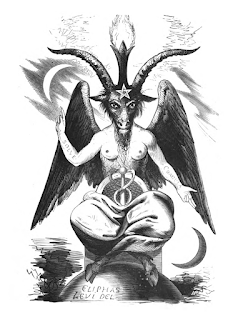
There is no question that Waite was very extensively influenced by Lévi, and his Devil is very clearly patterned after Lévi's Goat. We see the horns, the pentagram, the torch, the position of the arms, etc. -- all rather different from the way the Devil is typically portrayed in the Marseille tradition. However, Lévi's drawing also features feathered wings and a caduceus -- which appear not on Waite's Devil card but on his Two of Cups.

There is no lion's head on Lévi's Baphomet, though. For that, we need to look at another image: the myterious "Leontocephaline" (lion-headed) figure associated with Mithraism.


Notice the lion's head, the feathered wings, and the caduceus -- all the elements that feature in the Two of Cups. The exact identity of this figure is a matter of speculation and scholarly debate, but it has become conventional to refer to it as Arimanius -- that is to say, Ahriman, the "devil" of Zoroastrianism, whose name would later be used by Rudolf Steiner (and later still by my own circle of Romantic Christians) to refer to the materialistic, bureaucratic, "lawful evil" aspect of the demonic.

Are the two people on the Two of Cups drinking a toast to the devil, then? Ah, but the cups combined with the caduceus give an added meaning.


The cup and serpent is the Bowl of Hygieia, symbol of pharmacy. Here we have two cups and two serpents -- but the serpents are combined to form a caduceus, symbol of commerce. Isn't such an unholy combination precisely what we have in mind when we say "Big Pharma"? And isn't Big Pharma one of the primary manifestations of Ahriman in the modern world?

In this context, another detail of Lévi's Baphomet image becomes interesting: The monster's raised right arm is labeled "Solve," and his lowered left arm is labeled "Coagula." These have an alchemical meaning in their original context, but in the context of Big Pharma in 2022, it is impossible not to notice the resonance with a particular medical intervention, being pushed relentlessly by the Ahrimanic establishment, which is supposed to "solve" a supposed crisis but is actually causing a real crisis having to do with hematological "coagulation."

In addition to whatever Mithraic meaning it may have, the winged lion also appears in the Bible (Daniel 7) as a symbol of Nebuchadnezzar's Babylon. The "guardian of peace and security" statue that was briefly installed at the UN headquarters at the end of last year was connected by many with this beast, as well as with the Beast of Revelation -- which also represents "Babylon," meaning Rome.


Babylon, Rome, 666, the UN, Big Pharma -- Ahriman. The devil figure on these cards represents not some particular person who is the real power behind the throne, but rather the Ahrimanic System which is the power behind all thrones -- at least "till the thrones are cast down" (Dan. 7:9).

*

The Page of Wands (Biden)

There is little to add to my discussion of Biden in "Reading for 2022." However, the addition of Baphomet to the mix suggests a possible interpretation of the Devil setting fire to the Biden figure's tail with the torch he holds in his left hand. The corresponding arm on Lévi's Baphomet is labeled coagula -- could this be a hint that Biden could be removed from action by pharmacologically induced thrombosis? That would be a very plausibly deniable way of offing him wouldn't it -- Alec Baldwinning him next time he does a fake peck photo op? The effect needn't be immediate, either. The Devil card shows his tail being lit as if it were a fuse, which makes me think of these lines from the They Might Be Giants song "Hide Away Folk Family."

Tippy-toe to the front door, Mother,
'Cause there's a guy with a long, long fuse
And the one thing you can't hide is all the fear you feel inside
As the fuse is spelling out these words

Chorus:
Hide away folk family
Or else someone's gonna get ya (Someone's gonna get ya)
Someone's gonna get ya
Hide away folk family
Better hide away
Better hide away

Tippy-toe to the flat-bed, Father,
Because they're pouring out our gasoline
And sadly the cross-eyed bear's been put to sleep behind the stairs
And his shoes are laced with irony

Chorus

Hello. This is Lesley Down with the daily home astrology report.
Taurus: Contemplate domestic turmoil.
Aquarius: Abandon hope for future plans.

I'm not sure if the Taurus and Aquarius references mean anything, but it's interesting to note that Inauguration Day is often the day the Sun enters Aquarius.

*

The Queen of Cups (Harris)

Looking at all of the cards we are considering, we find Harris represented four times: twice as a woman with a cup, once as a woman with grapes growing from her tail, and once as a woman with a lion. This theme of cups and grapes reminds me that in Aleister Crowley's version of the Strength card (renamed Lust; in order to maintain his cred as the Wickedest Man in the World, Crowley renamed all three virtue trumps), the woman is portrayed as the biblical Whore of Babylon and is holding a cup.


Crowley himself characterizes this cup as "the Holy Grail burned with love and death," but in the Bible it is "a golden cup in her hand full of abominations and filthiness of her fornication" (Rev. 17:17), and "the inhabitants of the earth have been made drunk with the wine of her fornication" (Rev. 17:2). 

The identification (divinatory, not literal!) is clinched by the way this character is introduced in Revelation: "I will shew unto thee the judgment of the great whore that sitteth upon many waters" (Rev. 17:1). If you look at the Queen of Cups, you will see that she, too, sits upon many waters, her throne being on a tiny island or promontory, with water all around. Note also that Biden and Harris are often disparagingly referred to as "Joe and the Hoe" -- the latter title being nothing but a dialect version of the word used in Revelation.

Oh, and did I mention that "Crowley's" cards were actually painted by a woman named Harris?

Tuesday, November 3, 2020

Oswald Wirth's Emperor

The Emperor card in all three versions of Oswald Wirth's Tarot is essentially the same.

Three versions of Oswald Wirth's Emperor card (1889, 1926, 1966)

For comparison, here is Nicolas Conver's 1760 Emperor card, representing the mainstream Tarot de Marseille tradition.


Wirth differs from the standard Marseille design on the following points:

  • There are four points at the top of the crown and no points along the brim.
  • The scepter bears a fleur-de-lis rather than a globus cruciger.
  • The emperor holds a large globus cruciger in his right hand instead of holding his belt.
  • The emperor wears a breastplate with a sun and moon on it.
  • Instead of having a shield with an eagle leaning against his throne, the emperor sits on a large cube with an eagle on it.
  • The emperor's right leg is crossed under his left rather than over it.
  • The plant at the left side of the card is a red flower rather than grass.

Influence of Geneva and Besançon Tarots

Wirth was Swiss, born in the Canton of Bern in 1860, and his Emperor's scepter shows the influence of decks from that country. One thinks of the fleur-de-lis as a French symbol, but in fact the only pre-Wirth Tarot I have been able to find with anything like a fleur-de-lis on the Emperor's scepter is the one printed in the Canton of Geneva in 1840 by François Gassmann.


Gassmann's eagle appears to have influenced Wirth's as well. It is distinctive because of the stylized shape of its wings, suggesting German rather than French heraldic conventions, and because of the escutcheon on its chest. Wirth adopted the stylized wings for his 1926 and 1966 cards, and the 1889 version has what appears to be a lyre on the eagle's chest where the escutcheon would be.

Also relevant is the Tarot de Besançon which, despite taking its name from the French town to which production of the cards was moved in the 19th century, actually originated in Switzerland.

Johan Jerger (Besançon, 1801)

Jerger puts the traditional globus cruciger at the end of his Emperor's scepter, but the strange shape of the shaft itself clearly influenced the 1926 and 1966 Wirth cards. This is also the only pre-Wirth Emperor card I know of that features a flower. (Gassmann has an oak leaf; traditional TdM has only a patch of grass.) The 1926 and 1966 Wirth cards also follow the Tarot de Besançon in giving the Emperor a braided golden necklace but omitting the pendant.

Notice that on Jerger's card, the Emperor's legs are not crossed, and the left leg covers the right one. Jerger also gives the Emperor red hose, as does Wirth, whereas blue and green are the standard TdM colors. The Emperor's skirt is made up of separate tongues of material, like Greek armor, as in Wirth.

We can also see Besançon influence in the shape of the Emperor's beard, hair, and headgear.

Wirth (1889), Jerger (1801), Conver (1760)

There are no points along the brim, and the brim protrudes in the front. The central rib of the crown is divided into three parts. The small gold circles are perhaps influenced by the studs or rivets seen in the Besançon card.


Other innovations

Of the distinctive features of Wirth's Emperor, it appears that only three -- the globus cruciger, the cubic stone, and the breastplate -- cannot be traced to earlier Swiss cards.

The globus cruciger is easy enough to explain. Since it no longer appears at the end of the Emperor's scepter, Wirth places it in his hand instead. Bonifacio Bembo's Emperor card painted for the Visconti-Sforza family also shows the Emperor holding a scepter in his right hand and a globus cruciger in his left.

The association of the Emperor with the cubic stone of the Freemasons seems to originate with Éliphas Lévi, whose influence on Wirth is indisputable (see his Wheel of Fortune card, for instance). Here is Lévi's description of the Emperor card in Dogme et Rituel de la Haute Magie:

ד The porte or government of the easterns, initiation, power, the Tetragram, the quaternary, the cubic stone, or its base.

Hieroglyph, THE EMPEROR, a sovereign whose body represents a right-angled triangle and his legs a cross -- image of the Athanor of the philosophers.

The Athanor is an alchemical furnace; the triangle and cross is a symbol of alchemical Sulfur. Elsewhere in the Dogme et Rituel, Lévi refers to the cubic stone as a symbol of alchemical Salt, and also includes the prayer, "Angels of Netsah and Hod, establish me upon the cubic stone of Yesod!" (These are the 7th, 8th, and 9th sephiroth of the Tree of Life, with names meaning "eternity," "splendor," and "foundation," respectively.)

As for the breastplate with a sun on the right breast and a moon on the left, my hunch is that it must have reference to the Urim and Thummim, but I have not been able to find any specific source for this. In Dogme et Rituel, Lévi identifies the shoulder ornaments of the Charioteer as "the URIM and THUMMIM of the sovereign sacrificer, represented by the two crescents of the moon in GEDULAH and GEBURAH" (cf. the two "moon blocks" used in Chinese divination). Elsewhere in the same book, Lévi writes that "the URIM and THUMMIM were the above and beneath, the East and West, the yes and no." Wirth may have combined these two ideas -- the Urim and Thummim as crescent moons, and as polar opposites -- to arrive at his representation of them as sun and moon.


Influence on the Rider-Waite

The Rider-Waite Tarot was published in 1909 -- after the first version of Wirth's deck but before the two later versions -- and it shows the influence of that particular version of the card.


Here are the points the Rider-Waite Emperor shares with the 1889 Wirth.
  • The Emperor wears red clothing and armor. While the breastplate is not visible on the Rider-Waite card, the armored knees and feet are otherwise unique to the 1889 Wirth.
  • The Emperor's beard is long as in Wirth, rather than short and pointed as in the Tarot de Marseille.
  • The Emperor's legs are uncrossed -- closer to the posture in Wirth than in the TdM.
  • The throne, while not cubic, is made of gray stone as in the 1889 Wirth. (The ram decorations are due to Waite's ill-starred schema of astrological correspondences.)
  • The Emperor holds an orb in his left hand.

Tuesday, October 15, 2019

A rationale for Waite's orientation of ROTA

Yes, yet another post (see the others) on this very minor bit of Tarot iconography.

In a past post (qv), I wrote that "of the four possible orientations of the ROTA, the only one I can't think of any good reason for is the one actually used by Lévi and Waite, with T at the top!" Now a possible rationale for it has occurred to me.


Notice that the wheel is apparently turning counterclockwise: the snake on the left is descending, and the cynocephalus on the right is ascending. So the letters ROTA correspond, respectively, to the low point, the descent, the high point, and the ascent. Lévi had already identified the A and O of ROTA as corresponding to alpha and omega -- representing the beginning and the end. It seemed to me that the T and R ought to correspond to some similarly fundamental opposition, but nothing came to mind until today. T and R correspond to the Hebrew words tov (טוֹב, "good") and ra (רַע "bad/evil"). Obviously, the top of the wheel represents good fortune; and the bottom, bad fortune. One starts at the bottom, rises (alpha, the beginning), reaches the top, and then falls (omega, the end).

Saturday, June 8, 2019

Lévi's influence on Waite's Magician card

Here is part of A. E. Waite's description of his Magician card in The Pictorial Key to the Tarot.
A youthful figure in the robe of a magician, having the countenance of divine Apollo, with smile of confidence and shining eyes. Above his head is the mysterious sign of the Holy Spirit, the sign of life, like an endless cord, forming the figure 8 in a horizontal position. [. . .] In the Magician's right hand is a wand raised towards heaven, while the left hand is pointing to the earth. [. . .] This card signifies the divine motive in man, reflecting God, the will in the liberation of its union with that which is above. It is also the unity of individual being on all planes, and in a very high sense it is thought, in the fixation thereof.
And here is Éliphas Lévi's description of the same card in Dogme et Rituel de la Haute Magie -- as translated by none other than A. E. Waite.
א Being, mind, man, or God; the comprehensible object; unity mother of numbers, the first substance.
All these ideas are expressed hieroglyphically by the figure of the JUGGLER. His body and arms constitute the letter ALEPH; round his head there is a nimbus in the form of ∞, emblem of life and the universal spirit; in front of him are swords, cups and pantacles; he uplifts the miraculous rod towards heaven. He has a youthful figure and curly hair, like Apollo or Mercury; the smile of confidence is on his lips and the look of intelligence in his eyes.
The more of Lévi's work I read, the more I find him to have been the ultimate source of what I had previously thought to be Waite's own innovations.

Tuesday, May 28, 2019

The orientation of ROTA

I found this diagram in Éliphas Lévi's Rituel de la Haute Magie, included apropos of nothing, and with no caption or explanation given.


I don't feel like searching through Agrippa or whoever for the meaning of the various sigils around the edge of the picture, but the main theme is a familiar one: the wheel with ROTA/TARO written around its circumference, a symbol created by Guillaume Postel and much used by Lévi. The four suits of the Tarot also figure in the diagram. The wand (on the right) has the form of a double-headed Wenchang pen, as seen in the Rider-Waite deck, apparently yet another instance of Lévi's influence on Waite. The sword and cup are easily identifiable, and I suppose that the suit of coins is, as in Waite, represented by the "pentacle" -- which, as Lévi uses the word, need not take the form of a five-pointed star. (To break the connection with the numerical prefix penta-, Lévi prefers the nonstandard spelling pantacle, an innovation later followed by Aleister Crowley, with whom it is now primarily associated.)

What caught my attention was the apparent mismatch between the four suits and the four letters. The letter O is paired with the sword, but it resembles a coin. A sword has the form of a cross and should therefore be paired with T. The A used here by Lévi, like the one that appears on the Rider-Waite Wheel of Fortune card, has a flat or rounded top rather than a pointed one, so that when it is turned upside down it looks like a cross-section of a cup with some liquid in it. That leaves the letter R to be paired with the wand, which it does not particularly resemble. However, Spanish and Italian versions of that suit -- a heavy-headed club or mace, not a wand -- do suggest the Greek letter P, and the Sicilian asso di mazze even bears a certain resemblance to an R.


In an arrangement independently arrived at by Whitley Strieber in his book The Path, Lévi puts the cup at the bottom, the coin/pentacle at the top, the sword on the left, and the wand/club on the right. If we rotate our ROTA 90 degrees to the right, the upside-down A (which resembles a cup) will be lined up with the cup, and the O with the coin. Unfortunately, the sword has to be switched with the wand to make those correspondences work.


However, if we rotate the wheel again, so that the A is at the top, we can keep the Lévi/Strieber orientation of the suits. O works for the cup since it is round, and A (which in this case should be written in the usual angular fashion) matches the pentacle. Another word for a pentagram is pentalpha because it consists of five letter A's in different orientations. This mapping also means that the word ROTA gives the suits in their conventional order: wands, cups, swords, pentacles.


All that having been said, I still find that the orientation I prefer is the one with R at the top, matching both the Chrismon of Saint Ambrose (discussed in relation to the Wheel of Fortune here) and the cruciform halo of Christ in the Basilique Saint-Sernin de Toulouse (discussed in relation to the World card here).


(Note that the Christ carving shown is actually a modern one by Jonathan Pageau, based on the original in Toulouse. I chose it because the three letters are more clearly legible than they are in available photos of the original carving. Note also that the letter that looks like W is actually a lowercase omega, corresponding to O.)

In fact, of the four possible orientations of the ROTA, the only one I can't think of any good reason for is the one actually used by Lévi and Waite, with T at the top!

Thursday, April 25, 2019

The Reaper of Marseille


At first glance, there appears to be little to say about L'Arcane sans nom; it's just the Grim Reaper, a standard-issue symbol of death. Actually, though, it differs from the familiar symbol in significant ways. Our modern Reaper is always shrouded in a hooded cloak of black, hiding everything from view except (usually) the skull face and the skeletal fingers that clutch the scythe. (I originally wrote "his" in the preceding sentence but we must remember that death is a feminine noun in all Romance languages and is personified as such; the Grim Reaper is La Faucheuse. Éliphas Lévi calls her "that old queen of the world who is on the march always and wearies never . . . the sordid mistress of our tearful valley.") The Reaper of Marseille is naked. The other striking difference is that, while we are accustomed to seeing the Reaper holding his (sorry, "her") scythe ominously, the Tarot card shows it actually being used to cut human beings to pieces.

*

Where does the original Reaper symbol come from? The Bible compares death to sowing, not to reaping. "Except a corn of wheat fall into the ground and die, it abideth alone: but if it die, it bringeth forth much fruit" (John 12:24).

The earliest use of "reapers" in a death-like role is in the interpretation of the parable of the wheat and the tares (Matthew 13:36-43).
Then Jesus sent the multitude away, and went into the house: and his disciples came unto him, saying, "Declare unto us the parable of the tares of the field."
He answered and said unto them, "He that soweth the good seed is the Son of man; The field is the world; the good seed are the children of the kingdom; but the tares are the children of the wicked one; The enemy that sowed them is the devil; the harvest is the end of the world; and the reapers are the angels. As therefore the tares are gathered and burned in the fire; so shall it be in the end of this world. The Son of man shall send forth his angels, and they shall gather out of his kingdom all things that offend, and them which do iniquity; And shall cast them into a furnace of fire: there shall be wailing and gnashing of teeth. Then shall the righteous shine forth as the sun in the kingdom of their Father. Who hath ears to hear, let him hear."
The theme "the reapers are the angels" is taken up again in Revelation 14:14-20, this time with much clearer reference to death.
And I looked, and behold a white cloud, and upon the cloud one sat like unto the Son of man, having on his head a golden crown, and in his hand a sharp sickle. 
And another angel came out of the temple, crying with a loud voice to him that sat on the cloud, "Thrust in thy sickle, and reap: for the time is come for thee to reap; for the harvest of the earth is ripe."
And he that sat on the cloud thrust in his sickle on the earth; and the earth was reaped. And another angel came out of the temple which is in heaven, he also having a sharp sickle.
And another angel came out from the altar, which had power over fire; and cried with a loud cry to him that had the sharp sickle, saying, "Thrust in thy sharp sickle, and gather the clusters of the vine of the earth; for her grapes are fully ripe." 
And the angel thrust in his sickle into the earth, and gathered the vine of the earth, and cast it into the great winepress of the wrath of God. And the winepress was trodden without the city, and blood came out of the winepress, even unto the horse bridles, by the space of a thousand and six hundred furlongs.
The blood coming out of the winepress makes it clear that "the vine of the earth" bears human "grapes" and that the reaping angel is killing them. Still, though, as in Matthew, "the harvest is the end of the world." The reaping angel is not a symbol of ordinary death, but of the mass slaughter preceding the second coming. The biblical sickle -- and, even more so, the larger scythe wielded by the Tarot and post-Tarot reapers -- is a tool for cutting a swath through a field, severing hundreds of individual stems with each swing. One never speaks of "mowing down" a single victim.

Also, in the Bible the reaping is done by angels, and even by the golden-crowned Son of Man sitting on a cloud -- not by animated skeletons.

*

The animated skeletons (or nearly-skeletal corpses), which come to those Death has chosen and lead them away, are a familiar theme in medieval art -- the Danse Macabre or Totentanz -- but these personifications of death do not cut down their victims with scythes but rather take them by the arm and lead them away. They are rarely armed at all, and when they are, their weapon of choice is not necessarily the scythe. The Nameless Arcanum from the Visconti-Sforza deck has a skeleton with a longbow and arrow, for instance, striking from a distance like far-darting Apollo.

One theory is that both the change from angels to corpses and the introduction of the scythe occurred as a result of the Black Death, when corpses became a familiar sight and when people were indeed being "mown down" on a scale suggestive of the Apocalypse. By the time the plague had ended and regularly scheduled programming had been resumed, the image of Death as a scythe-wielding skeleton had become a permanent fixture of the popular imagination.

It has also been suggested that the Reaper's scythe originally belonged to Father Time -- who in turn got it from the harvest god Saturn, the conflation of Cronos/Saturn with the similarly named Chronos/Time having been a common error since antiquity. The identification may have been reinforced by the myth of Saturn devouring his own children, tying in with the image of time the devourer in Ovid:
Tempus edax rerum, tuque, invidiosa vetustas,
omnia destruitis vitiataque dentibus aevi
paulatim lenta consumitis omnia morte!
Thou glutton Time, and Age that envièth,
All things you wreck, and tear them with your teeth,
Consuming all, by slow degrees, in death.
Once the hybrid figure of Father Time has been created, bearing the hourglass of Chronos and the scythe of Cronos -- what can the latter implement be for if not to cut down those whose sand has run out? From that to the Grim Reaper is but a short step.

If the Reaper did in fact develop out of Father Time, it would make the Nameless Trump a close art-historical cousin to the Hermit, whose lantern was originally an hourglass and whose earliest names were Vecchio (Old Man) and Tempo (Time) -- a bit surprising given the stark contrast between that serene old man and this ghoulish hacker-to-bits!

*

The image of the Reaper actually using her scythe -- and not only to kill but to dismember -- is, as far as I know, original to the Tarot and does not exist in pre-Tarot allegories of Death.

For me, the severed body parts that litter the ground are a key part of the meaning of this trump, and I have commented on them before, in relation to Marcus Aurelius's advice to aspiring nihilists Stoics to "look at the individual parts and move from analysis to indifference." Death is fundamentally a matter of severing connections, dissociating parts, de-composing -- which is why analysis can kill.

Tuesday, April 9, 2019

The Wheel of Fortune: Rider-Waite


For the most part, Waite's version of the Wheel of Fortune is a synthesis of two of Lévi's designs. The disc itself is copied very closely from the Sanctum Regnum, while the creatures around its circumference are based on those in the Clef. Waite says as much in his Pictorial Key to the Tarot: "In this symbol I have again followed the reconstruction of Éliphas Lévi, who has furnished several variants. [. . .] I have, however, presented Typhon in his serpent form."

While the Wheel of Fortune is traditionally represented as either standing in the ground or mounted on a post, Waite has it floating in the sky -- a choice which presumably reflects Lévi's association of it with the wheels of Ezekiel. Rather than an actual wheel with hub, spokes, and rim, it has become a solid disc marked with lines suggesting those features. For the most part, the disc is identical to the one portrayed in the Sanctum Regnum, but there are a few changes. The physics terms have been removed, as have the 24 red "paw-prints" accompanying the letters of the Tetragrammaton. (Of these, Lévi's Transcendental Magic says that to "these four-and-twenty signs, crowned with a triple flower of light, must be referred the twenty-four thrones of heaven and the twenty-four crowned elders in the Apocalypse.") The letters TARO have been moved onto the disc itself, replacing the images of the four living creatures, and the latter have been moved to the four corners of the card and rearranged so as to correspond to the fixed signs of the zodiac rather than to the vision of Ezekiel. Each of the living creatures is holding (and perhaps reading?) a book -- an iconographic convention that normally indicates that the creatures are being used as symbols of the four evangelists, Matthew (the man), Mark (the lion), Luke (the ox), and John (the eagle).

A further oddity is the Hebrew letter yodh -- the first letter of the Tetragrammaton, located at 1:30 on the wheel -- which at first glance appears to have been rotated 90 degrees from its proper orientation. If you try to correct this error by rotating it, though, you will find that it is impossible -- that what we have is actually a rotated mirror image of the Hebrew letter.


I find it hard to believe that Waite could have made such an error. These Golden Dawn types were completely obsessed with the Tetragrammaton, and the letter yodh was a particular favorite of Waite's; a sort of "yodh confetti" appears as a decorative motif on several of his cards (the Aces of Cups and Swords, and the Moon). I suppose this sort of error is easier to make when a word is being written around the circumference of a circle rather than horizontally, and we must also keep in mind that the card was actually drawn by Pamela Colman Smith rather than by Waite himself, but I still find it surprising -- particularly given that they had Lévi's picture, with its correctly oriented yodh, to copy from. If the modification was deliberate, Waite must have meant something by it, but I can't imagine what. (This anomalous yodh has been preserved, whether deliberately or through ignorance of Hebrew, in some other Rider-Waite-based decks, such as the Hanson-Roberts, BOTA, etc.)

Hebrew is read from right to left, a fact which occultists have considered significant. (For example Jean-Baptiste Alliette, the first known professional Tarot reader, is better known as "Etteilla" -- that being the "kabbalistic," i.e. right-to-left, reading of his name.) If we start at yodh and read from right to left -- that is, counterclockwise around the disc -- we will find the Tetragrammaton interspersed with the letters TORA in that order. I am not aware of Lévi's ever having mentioned TORA as another possible reading of ROTA/TARO, but Waite was certainly aware of it. On his High Priestess card, the priestess holds a scroll labeled TORA -- or perhaps it is the more conventional spelling, Torah; the part of the scroll where the final h would be written is hidden inside the folds of the priestess's gown. Waite's decision to hide or omit the h shows that he intended to link the Torah with the Wheel and the Tarot -- and, via the staurogram, with the Cross. I am reminded of the Bible Wheel created (but no longer endorsed) by Richard Amiel McGough; it involves "rolling up" the 66 books of the Protestant Bible like a scroll, creating a wheel-shaped diagram which McGough links with cruciform halos of the type worn by the Saint-Sernin Christ. The word torah means "law," which is also the meaning of dharma; I have already pointed out the Wheel of Fortune's similarity to the Dharma Wheel of Buddhism.

A deck of cards is like a codex, which is like a scroll, which is like a wheel, the spokes of which are like a cross -- all these things can be linked. The question is whether all this linkage has any coherent meaning, and specifically whether it has anything to do with the original Wheel of Fortune concept. We shall return to this question later.

*

Turning now to the three creatures positioned around the wheel, we find that they are based on Lévi's but differ in important ways. The sphinx is blue as in the Tarot de Marseille and wears an Egyptian headdress as in the Clef, but it has no wings, and it appears to have its tail between its legs like a beaten dog. Like its Marseille counterpart, and unlike Lévi's version, it holds its sword in its left hand and appears to be almost cradling it rather than wielding it -- presumably because it is after all a sphinx and lacks opposable thumbs. Strangest of all, Waite's sphinx is holding the sword by the blade rather than by the hilt! The sword is in the "hands" of a creature completely incapable of using a sword -- a strong indication that Waite does not see the sphinx as some idealized depiction of a fully realized Man.

The creature on the bottom right side of the wheel corresponds to Lévi's Hermanubis -- a conflation of the Greek Hermes and the Egyptian Anubis, bearing the caduceus of the former and having the dog's head of the latter. Waite's version has no caduceus and thus cannot be clearly identified as Herm-anubis as opposed to common-or-garden Anubis. He is completely naked, even though both Anubis and Hermanubis -- and even the dog of the Marseille card -- are always depicted with clothing; and is red, even though Anubis's characteristic color is black. (I assume the blue sphinx, yellow snake, and red cynocephalus comprise a color scheme corresponding to some alchemical folderol or other, but who knows.) The position of this creature is also very strange. Rather than grasping or climbing the wheel, as those in his place generally do, he has his back to it and is somehow adhering to it in defiance of gravity. He is also so positioned as to occupy two of the traditional stations of the Wheel simultaneously: the bottom (sum sine regno) and the rising position (regnabo). Anubis as the god of embalming and mummification, and as psychopomp (whence the identification with Hermes), is connected both with death and with the hope of resurrection

The snake is also defying gravity, barely even touching the wheel. Waite explicitly tells us that it is "Typhon in his serpent form," so it is presumably based on the Proteus/Typhon figure labeled "hyle" in the Clef. Typhon did not really have a "serpent form"; like his mate Echidna, he was only part serpentine, and is generally portrayed as a winged giant with snake-like legs. Waite has perhaps confused him with Python, with whom he is associated (but not identified) in the Homeric hymns. The choice of a serpent for the descending creature perhaps reflects biblical symbolism. Typhon made war on Zeus and was cast down into Tartarus -- like "that old serpent, called the Devil, and Satan, which . . . was cast out into the earth" after losing the "war in heaven" described in Revelation 12. Waite's comments in the Pictorial Key suggests that all three of the creatures around the wheel are supposed to be examples of "Egyptian symbolism," so he must have had in mind the longstanding tradition identifying Typhon with the Egyptian god Set -- but Set was never portrayed as even partly serpentine. If the snake is an Egyptian symbol, I would naturally identify it as Apep. While Set is considered to be the Egyptian Typhon, and while Set and Apep are definitely distinct characters, it would perhaps not be too much of a stretch to think of Apep as "Typhon in his serpent form." Apep is appropriate for the descending position on the wheel because he is the quintessential defeated monster. The Egyptians never portrayed him except as being defeated by Ra or Set or one of the other deities, out of a superstitious fear than any other portrayal would give power to Apep.

*

Overall, I have to admit that my first impression of the Rider-Waite version of this card is that Waite made rather a mess of things, presenting a congeries of symbols with no organic connection with one another. But perhaps a bit of randomness is appropriate enough for a card representing Fortune.

Sunday, April 7, 2019

The staurogram, the eight-spoked wheel, and the Wheel of Fortune

In my recent post on Éliphas Lévi's influence on the Wheel of Fortune Tarot card, I discuss the staurogram, consisting of the Greek letters TAPΩ, its probable influence on the image of Christ seen in the Basilique Saint-Sernin de Toulouse, and its incorporation by Lévi into his eight-spoked "Wheel of Ezekiel."

Since writing that post, I have discovered the Chrismon of Saint Ambrose (engraved on one of the walls of Milan Cathedral), which combines the staurogram (TP) and Labarum (XP) into a single glyph, resembling an eight-spoked wheel.


The eight-spoked wheel was itself an early Christian symbol, representing, like the better known "Jesus fish," the Greek word ΙΧΘΥΣ ("fish"), used as an acronym for Ἰησοῦς Χριστὸς Θεοῦ Υἱὸς Σωτήρ ("Jesus Christ, Son of God, Savior").


This confirms me in my opinion that, given that Lévi wanted to incorporate a Latinized staurogram into his Wheel of Fortune, where it could be read either as ROTA or as TAROT, he really should have put R at the top of the wheel rather than T. But the real question is whether Lévi had any business identifying Christ and the cross with the Wheel of Fortune in the first place. The Wheel is a symbol of futility and meaninglessness, of endless repetition, of rising only to fall again. What has any of that to do with Christ?

*

In his comments on the Chrismon of Saint Ambrose in La bolla di Maria (available in Italian here; see p. 15), Pietro Mazzucchelli connects the eight spokes of the Chrismon with the eight Beatitudes of the Sermon on the Mount. We can find an exact analogue in the Buddhist Dharmachakra -- an eight-spoked wheel  representing the Noble Eightfold Path that leads to enlightenment.


This wheel is a basic Buddhist symbol -- so much so that, in countries where Nazicentrism has rendered the swastika unacceptable, it has become the standard iconic representation of Buddhism, taking its place alongside such icons as the cross, the crescent, and the star of David.

The strange thing is that the wheel, in the form of the Bhavachakra or Wheel of Life, is also the standard Buddhist symbol of samsara -- the endless, meaningless cycle of birth, death, and rebirth from which Buddhism is meant to save us. Can we see in Lévi's conceit a Christianization of the same concept -- the transformation of a symbol of futility and nihilism into a symbol of salvation from the same? In the cross itself, a symbol of death has become a symbol of victory over death; could the Wheel be an extension of the same idea?

A wheel (when not mounted on a fixed stand, as it sometimes is in the Tarot) represents the transformation of cyclical repetition into forward, linear motion. As the wheels of a chariot turn, the chariot itself moves forward. 

Friday, April 5, 2019

The Wheel of Fortune: Éliphas Lévi

While Éliphas Lévi did not create a Tarot deck, His influence on the Rider-Waite version of the Wheel of Fortune card is so substantial that he deserves a post of his own.

In Dogme et Rituel de la Haute Magie (published 1854-56, translated by Waite in 1896 under the title Transcendental Magic), Lévi makes the connection between the words tarot and rota (Latin for "wheel," as in rota fortunae) and associates them with the Tetragrammaton:
The incommunicable axiom [on which the Great Magical Arcanum depends] is enclosed kabalistically in the four letters of the Tetragram, arranged in the following manner: In the letters of the words AZOTH and INRI written kabalistically; and in the monogram of Christ as embroidered on the Labarum, which the Kabalist Postel interprets by the word ROTA, whence the adepts have formed their Taro or Tarot, by the repetition of the first letter, thus indicating the circle, and suggesting that the word is read backwards (Transcendental Magic, Book 1, pp. 19-20).
The above text is accompanied by the following illustration:


In the center we can see the Tetragrammaton -- God's name in Hebrew, usually rendered Jehovah or Yahweh in English -- flanked by INRI (for Iesus Nazarenus Rex Iudaeorum, "Jesus of Nazareth, King of the Jews") and by a variant of the Labarum made up of the Greek letters TAPΩ, corresponding to the Latin TARO. (I don't know where we are supposed to see the word AZOTH.)

The Labarum of Constantine properly consists of the Greek letters XP (the first two letters of Χριστός, "Christ"), often accompanied by A and Ω ("Alpha and Omega" being a title applied to Christ in the book of Revelation). Lévi's variant, with T instead of X, can hardly be called "the monogram of Christ," but it turns out to be a genuine Christian symbol, known as the staurogram because it was originally used to abbreviate the Greek word σταυρός, "cross" -- shortened to στρός, with the T and P written as a ligature. Like the XP ligature of the Labarum, the TP ligature was later often accompanied by A and Ω. The image below was found on a Catholic website having nothing to do with Lévi or the Tarot.


With only a single T, this gives us taro -- the root vegetable, not the card game. This is where Lévi is, as he indicates, indebted to Guillaume Postel, who in his Key of Things Kept Secret from the Foundation of the World described a complicated symbol which involved writing the word ROTA (and HOMO, and DEUS, and various other things) around the circumference of a circle. Lévi noticed that when ROTA is thus written, one could just as well begin with the T as the R and read TARO, after which we would arrive again at the T, giving us TAROT. (Despite what Lévi implies, Postel himself did not connect his ROTA with either the staurogram or the Tarot. See details here.)

Incidentally, the staurogram, with A on the left, Ω on the right, and P at the top, sheds some light on something that has perplexed me for a long time: the letters on the cruciform halo of the Maiestas Domini image at the Basilique Saint-Sernin de Toulouse (a sculpture I discuss extensively in my post on the World card). Cruciform halos generally bear the letters  Ὁ ὬΝ ("the existing one"), but this one -- uniquely, so far as I know, and I've looked at a lot of Maiestas Domini images -- bears the letters A, Ω, and R -- a strange mixture of the Greek and Latin alphabets.

Letters enlarged for clarity
Now I assume that the halo is based on the staurogram, with the cross itself representing T. The P has been Latinized as R, but the Ω has not; its significance is that it is the last letter of the alphabet ("Alpha and Omega, the beginning and the end"), so changing it to O is out of the question. It is interesting that this particular Maiestas Domini, which I consider to have been uniquely influential in the development of the Tarot, should (also uniquely) include the letters TARΩ in its design.

Lévi's La clef des grands mystères contains this representation of the Wheel of Fortune.


Aleister Crowley's English translation of the Clef adds a note describing the figure thus:
It is a type of the Wheel of Fortune. The wheel itself is erected on a wooden post, and has a crank affixed to the hub. There is no image of Fortuna to turn it. The base of the post is held by a blunt double crescent on the ground, rounded horns slightly up and in parallel like a hot-dog bun. Two nosed serpents issue from the base, cross once and arch toward the post just below the wheel. The wheel is double, having an outer and an inner ring with eight spokes running through both rims. The spokes have a circular expansion with central hole inside and a bit short of the inner rim. These spokes appear to be riveted to the inner rim. At the top of the wheel is the Nemesis seated on a platform as a sphinx with a sword: head cloth, stern male face and woman’s breasts, winged. The sword is hilt to wheel and up to left. 'ARCHEE' is written over the wing to the left. Rising on the right of the wheel is a Hermanubis or variation of Serapis: Dog’s head, human body, carries a caduceus half hidden behind head and wheel, legs before wheel. 'AZOTH' is written above the head of this figure. A demon reminiscent of Proteus descends the wheel on the left. His head is bearded and horned, his legs are tentacular and finned. He carries a trident below. 'HYLE' is written below his head.
Hyle of course means "matter," while Archée (Archeus) and  Azoth are alchemical terms. Archée is defined at this site (in French) as "the immaterial principle of organic life, different from the intelligent soul" -- in other words, something like what is normally called an "astral body." Azoth, which normally refers to the element mercury, is used by Lévi to refer to "the Universal Magical Agent" or "Universal Medicine,"which he explains as follows: "The Azoth or Universal Medicine is, for the soul, supreme reason and absolute justice; for the mind, it is mathematical and practical truth; for the body it is the quintessence, which is a combination of gold and light. In the superior or spiritual world, it is the First Matter of the Great Work, the source of the enthusiasm and activity of the alchemist. In the intermediate or mental world, it is intelligence and industry. In the inferior or material world, it is physical labor." In other words, it can be just about anything, and the precise nature of its relationship to matter and to Archeus is unclear.

It terms of its apparent influence on Waite, the important things to notice about this image are: (1) the striped Egyptian headdress on the sphinx, replacing the traditional crown; (2) the dog-headed man Hermanubis, replacing the dog; and (3) in place of the monkey, a bearded demon with "tentacular" legs, connected by Crowley with Proteus but equally resembling traditional representations of Typhon.

Waite was influenced even more directly by the treatment of the Wheel in The Magical Ritual of the Sanctum Regnum, "translated from the MSS of Éliphaz Lévi and edited by W. Wynn Westcott, M.B., Magus of the Rosicrucian Society of England" and published after Lévi's death, in 1896. It features illustrations which are "facsimile copies of Lévi's own drawings," and there are notes in Westcott's own voice at the end of each chapter. The illustration we are interested in is this one, accompanying a chapter which is called "The Wheel of Fortune" but actually discusses only the "Wheel of Ezekiel."


Again we have an eight-spoked wheel, and the word ROTA/TARO is written along its circumference, interspersed with cursive writing not notable for its legibility. (Reading clockwise from the top, I believe it reads "T électricité chaleur magnétisme lumière" -- meaning, as I suppose is fairly obvious, "electricity, heat, magnetism, light." It is not clear what these terms, borrowed from physics, have to do with anything.)

I would have rotated the word 180 degrees, with R at the top, O on the right, T at the bottom, and A on the left -- corresponding to the orientation of the staurogram and of the Saint-Sernin sculpture. This orientation would also make ROTA the most natural reading, with TARO as a hidden second meaning, rather than the reverse. Furthermore, the letter A, turned so that its point is to the left, exactly resembles the Phoenician aleph -- which means "ox" and thus corresponds to the ox which occupies that position on the Wheel.

The design also features the four letters of the Tetragrammaton and the four living creatures of Ezekiel. (The living creatures are arranged according to the vision of Ezekiel and the camp of Israel, rather than in the astrological arrangement commonly used in the World card. See details here.) The other characters on the Wheel are alchemical symbols, three of which represent the tria prima of Paracelsus: sulfur, mercury, and salt.
These are the three primes, but the Wheel design calls for a fourth -- so Lévi, for reasons I do not pretend to understand, chose the astrological sign for Aquarius, sometimes used in alchemy to represent water, though an inverted triangle is more usual. I am also unsure as to why the sulfur glyph has been rotated 90 degrees but the one for salt has not.

Westcott's notes, appended to Lévi's text on the Wheel of Ezekiel, describe the card in question as follows: "The Tarot Trump marked 10 is named the Wheel of Fortune; the card shows a wheel supported on two upright beams. Hermanubis stands on one side, and Typhon on the other; above is the Sphynx holding a sword in its Lion's jaws. [. . .] This key is figured by Lévi in his Clef des grands mystères, page 117."

Although he references the illustration in the Clef, reproduced above, Westcott's description differs in several particulars from the published version of that illustration. He describes the wheel being supported on two beams rather than one, says the figures on the sides are standing beside the wheel rather than clinging to it, and has the sphinx holding a sword in its jaws rather than its hand. (This last is particularly strange, since human-headed sphinxes don't generally have lion's jaws! He must have meant to write "claws.") He also identifies the Hyle figure as Typhon rather than Proteus, an identification Waite would later follow.

A darker view of the Three of Pentacles

Since June 9, 2024, I have seen the Three of Pentacles as being primarily a dark or negative card, even though Waite's Pictorial Key to ...