As the first Tarot trump (a position he invariably holds in all known historical orderings of the trumps), the Magician serves as our introduction to the whole series of 21 trumps (or 22, if the Fool is counted). And, at least in English, his name implies that he represents the key to the whole system, insofar as the Tarot is conceived as having something to do with magic. Any interpretation of the Tarot as a whole must begin by coming to terms with this rather slippery character.
Matters are complicated by the fact that “the” Magician card is actually a family of more-or-less related images appearing in the various versions of the Tarot, but the three specimens below — the Three Magi, shall we call them? — cover the main currents of the tradition. Since they represent the Italian, French, and English schools of the Tarot, respectively, it will be convenient to refer to each by the title given him in his native country: the Bagatto, the Bateleur, and the Magician.
 |
| From left to right: Il Bagatto, Visconti-Sforza deck (Italy, 15th century, oldest surviving Tarot); Le Bateleur, Tarot de Marseille (France, 17th century, “classic” Tarot); and The Magician, Rider-Waite deck (England, 20th century, extremely popular) |
Looking at these three images, several common threads are immediately obvious:
- a young man, colorfully dressed (in red or motley), with a more-or-less lemniscate-shaped hat or halo, holding a rod or wand
- a rectangular table set with an assortment of items, among which are invariably included a yellow cup, a knife or sword, and a circular yellow object or two
- the presence of some sort of vegetation (unless, in the Bagatto’s case, it’s only a green floor)
Despite these surface similarities, a closer look reveals that these three cards represent three entirely different conceptions of who the central figure is and what he is doing. Let us examine each in turn.
*
Il Bagatto
The first thing one notices about the Bagatto is the strange way he is holding his magic wand, almost as if it were a pen — and in fact, closer inspection reveals that that is exactly what it is: something along the lines of an Egyptian reed pen, but rather longer than was customary, and with nibs at both ends. In his excellent and well-researched post The First Tarot Magician, Dr. Michael Pearce argues that all the items on the Bagatto’s table are tools for writing. The knife is a pen knife, for cutting nibs; the cup is for ink, as are the small yellow objects (“seashells or little cups for ink”). As for the strange white object under the Bagatto’s right hand, Dr. Pearce identifies it conclusively as a sea sponge, used by writers of the period for cleaning pens and erasing. It may not look much like a sponge, but Bonifacio Bembo, the artist who painted this deck, also did some pictures of grail knights retrieving holy relics, among which was the sponge with which Jesus was given vinegar to drink on the cross, and the sponge in those pictures looks exactly like the Bagatto’s white object.
As further proof of the identity of the Bagatto’s objects, Dr. Pearce compares the card to a roughly contemporaneous picture by another artist depicting a writer, also with his pen, knife, ink pot, and sponge.
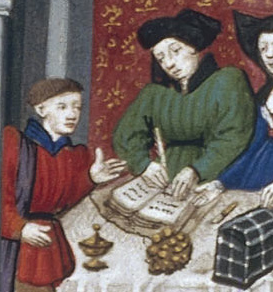 |
| Detail of an illustration from a 15th century Decameron, lifted from Dr. Pearce’s post |
He also identifies the Bagatto’s clothing as that typical of Italian scholars of the 15th century, and particularly of graduates of the University of Bologna. I find Dr. Pearce’s interpretation of the Bagatto card completely convincing. We are clearly looking at a writer or scholar, not a prestidigitator or a ceremonial magician. (This explains, incidentally, why the Bagatto, unlike his French and English cousins, is seated.)
Identifying the Bagatto as a writer is a necessary first step to understanding the card, but several unanswered questions remain — the most obvious being, why hasn’t he got anything to write on? The writer depicted in the Decameron illustration above has a pen, a knife, an inkwell, a sponge, and a book — but you will search the Bagatto card in vain for the tiniest scrap of paper, parchment, vellum or anything of the kind. That’s a pretty big omission, and there must be a reason for it. After all, if the Bagatto had been depicted holding his pen over a book, or at least a piece of paper, it wouldn’t have taken a trained art historian to figure out that the guy is supposed to be a writer! (Interestingly, and perhaps not coincidentally, the conspicuously absent book does show up in the next trump, in the hands of the Papessa, or High Priestess.) Despite the lack of paper, the Bagatto is holding his pen as if in the act of writing and is reaching for his sponge. Is he writing on the table itself? But there are no marks on the table. Come to think of it, there’s no ink visible, either — not on the pen, despite the clearly visible nibs, nor in any of the three items identified as inkwells.
The pen itself is pretty strange, too. Why is it so long (at least three times the length of a normal reed pen), and why does it have nibs at both ends? Is the idea that as he writes on the table he is simultaneously (and equally invisibly) writing in the air? As above, so below? Actually, that makes for a pretty handy symbol of magic. And is there a reason he is depicted with a reed pen rather than the more common and more readily identifiable quill pen? Dr. Pearce’s detective work regarding the sponge reminds me that it was on the end of a reed — and surely one longer than an ordinary pen — that the sponge was lifted to the lips of the Crucified (Mark 15:36, Matt. 27:48); could any such allusion be intended here? It may also be significant that the ancient Egyptians used reed pens, and that Thoth (both the inventor of writing and the patron of magic) is often depicted using one. The tradition that the Tarot is in some sense the “book of Thoth” is well known.
Finally, are those two little yellow things really receptacles for ink? Isn’t one inkwell enough? Isn’t it almost irresistible to identify them instead as coins? One needn’t be as explicit about it as Waite (who, with his characteristic subtlety, went ahead and transformed the pen knife into a honking big sword), but isn’t it hard to avoid seeing the four Tarot suits echoed in the Bagatto’s paraphernalia? It is traditional to interpret the suits of wands, cups, and swords, as representing will, emotion, and intellect, respectively — and considering the Bagatto’s tools in that light yields apparently meaningful mappings: the pen of will, the ink of emotion, and the pen knife of intellect. Where the coins fit into the picture is not clear, but there might not even be any coins in the picture after all. At any rate, three of the four suits are very clearly alluded to.
So, to sum up, the Bagatto represents the magician in his aspect as scholar or writer. Think of thrice-great Thoth inventing his hieroglyphics, John Dee writing his Monas Hieroglyphica, a Taoist magician writing out spells on paper (to be burned, and the ashes mixed with water and drunk), or the post-Renaissance image of the magician as a learned porer-over of dusty tomes. Or perhaps that last example should be scratched from the list; it is the passive, reflective book-clutching Papessa of the second trump who is the reader, whereas our Bagatto is essentially an active, creative writer.
*
Le Bateleur
The Bateleur clearly seems to have evolved from a Bagatto-style image. His headgear is roughly similar, though the rest of his outfit could certainly no longer be mistaken for the garb of a scholar. The assortment of objects on his table also appears to be based on the Bagatto’s tools, though their original character as writing instruments has been forgotten. The sponge has disappeared (or perhaps morphed into a bag), but everything else is still there. The knife and the yellow cup particularly stand out as being virtually identical to the Bagatto’s. The knife has acquired a sheath, there is now a second cup, and the number of indistinct roundish objects has multiplied considerably. The only really new additions are the bag and a pair of dice.
Dice — and I owe this insight to John Opsopaus, creator of the “Pythagorean Tarot” — very likely have something to do with why the Tarot deck has the precise number of cards it does. Rolling two dice yields one of 21 possible combinations of numbers, and when three are rolled the number of possibilities is 56. That the Tarot is made up of 21 trumps and 56 suit cards (plus the unnumbered joker-card of the Fool), and that the first trump features a pair of dice among the Bataleur’s suit-symbols, can’t be a coincidence.
Or, rather, it can be a coincidence, but by even thinking and writing about the Tarot we’ve sort of agreed to take the coincidental — better to say the unplanned — seriously. Whether or not the cards of the Tarot deck ever represented particular rolls of the dice, the Tarot’s very character as a deck of cards — designed to be shuffled for “random” selection and combination — implies that chance and serendipity were meant to play a role in its use. More than that, the individual pictures themselves owe quite a bit to serendipity. After all, Le Bateleur is, to every appearance, simply a misunderstanding, a misinterpretation — a corruption — of Il Bagatto. The Italian cards are much older, and while everything on the Bagatto’s table (with the possible exception of the two little yellow things) makes sense in its context, the same cannot be said of the Bateleur. For example, is a pen knife one of the items you would naturally include on a street magician’s table? It’s there because it was there on the Italian card, and it was copied by someone who didn’t understand what it meant. Not every version of Le Bateleur includes dice, either. Marteau's Grimaud deck has two dice, for example, and Noblet’s has three; but Conver’s and Dodal’s just have two more indistinct roundish things. Their transformation into dice, like the interpretation of the card as a whole as depicting a street magician, was likely a mistake pure and simple. Something similar is probably true of nearly every card in the deck. Much ink has been spilled, for example, about the meaning of the enigmatic image on the Temperance card, with its stream of liquid flowing from one cup to another, but it was originally just someone pouring water into wine to dilute it, demonstrating the virtue of temperance in the prosaic sense of “not drinking too much.” The Hermit card, evocative as it is, was just a standard-issue allegory of Time before someone mistook the hourglass for a lantern. Even the four suits are very likely descended from Chinese money-suited cards (coins, wands, and cups being cousins to modern Mahjong’s dots, bamboos, and characters), originally representing nothing deeper than various denominations of money. (Dots were originally coins; bamboos, strings of a hundred coins. Swords and cups likely derive from the Chinese characters for ten and ten thousand, respectively.)
There’s a scene in the Monty Python movie Life of Brian where Jesus is preaching the Sermon on the Mount and people in the crowd are struggling to hear him clearly. “I think it was, ‘Blessed are the cheesemakers,'” says one of them. “What’s so special about cheesemakers?” asks another. “Well, obviously it’s not meant to be taken literally. . . .” Now, I have not the slightest doubt that, if pressed, I could come up with a very clever interpretation of cheesemaking as a metaphor for something beatitude-worthy, but this would obviously be an exercise in futility, since “cheesemakers” is simply an error and as such has no meaning. Before going any further with our interpretation of the Tarot, we had better make sure that we are engaging in something more meaningful than mere cheesemaker-exegesis.
But the analogy — that of the words of Christ himself being corrupted into nonsense — is a poor one. In the case of the Tarot, what we have is not a case of some primordial revelation becoming increasingly garbled over time and losing its profundity, but rather precisely the opposite. As shown by several of the examples already mentioned, there is every indication that the Tarot began its career as a set of money-suited cards and stock allegories and has since
evolved into something much deeper. The oldest version of the cards is not necessarily the truest, and what are superficially “mistakes” in the transmission of tradition may in fact be successive steps in the orthogenetic development of the deck. Valentin Tomberg addresses this idea in the 10th letter of his
Meditations on the Tarot.
From the point of view of iconography [the Wheel of Fortune] is clearly mediaeval (of the late Middle Ages), as all the other Cards are, but intrinsically it is older, notably pre-Christian.
Is it the oldest or is it simply the least evolved of the twenty-two Cards of the Major Arcana of the Tarot?
The twenty-two Cards of the Major Arcana of the Tarot being an organism, a complete whole, it is not a question of diverse and disparate origins of particular Cards, but rather of the degrees of their evolution or transformation. For the Tarot, also, is not a wheel, a closed circle, but rather a spiral, i.e. it evolves through tradition and reincarnation.
The authors who saw in the Tarot the “Sacred Book of Thoth” (Thoth = Hermes Trismegistus) were both right and wrong at the same time. They were right in so far as they traced back the history of the essence of the Tarot to antiquity, notably to ancient Egypt. And they were wrong in so far as they believed that the Tarot had been inherited from ancient Egypt, i.e. that it had been transmitted from generation to generation subject to minor iconographic changes. [. . .]
No, the Tarot is not inherited, it has reincarnated. It has “reincarnated” in conformity with the experience of modern depth psychology of the school of Jung, who ascertained the upsurge of ancient and even archaic mysteries and cults from the depths of the unconscious of people in the twentieth century. The Tarot is the “Sacred Book of Thoth”—not inherited or transmitted—but reborn.
This idea of the Tarot as the “reincarnation,” rather than the lineal descendant, of the Book of Thoth, is an intriguing one. As with a human reincarnate, the lineal ancestors of the Tarot may be ordinary enough, but it “evolves through tradition and reincarnation” — and apparent mistakes from the point of view of tradition may in fact be subject to the secret influence of something along the lines of a Sheldrakean “morphic field.” Not all who wander from tradition are lost.
A recent comment by Bruce Charlton in a discussion on the meanings of dreams (qv) also seems relevant here.
By analogy consider a myth: what is The myth of King Arthur, or Robin Hood or Merlin? The answer is that there is no canonical or definitive myth, but only many different versions; yet somehow we feel that behind all the versions is a true myth, which operates without words or pictures but at a level of feelings.
So the idea would be that that is the true meaning of a dream: the myth behind the dream – the same deep myth might lead to many different surface dreams.
A Tarot card like the Magician may also be considered analogous to a legendary figure like Arthur or Robin Hood. It exists in many different versions, some of which constitute a more serious contribution to the myth than others. (The Marseille deck is to Tarot what Malory is to the Arthur legend; the recent spate of mostly lightweight “theme” decks has its parallel in the succession of Hollywood Arthurs and Oo-de-lally Robin Hoods.) With the Tarot, as with Arthur and company, the “original” or “historical” version is a matter of speculation but may well have been rather more prosaic than the multifarious myth that has since grown up. Yet, as Bruce says, behind all the versions lies a single myth — and, despite its unhistorical nature, a true one. Anyone who takes any sort of myths or traditional lore seriously must believe something like that. The mechanism by which such “true myths” materialize is an open question, but for now Tomberg’s metaphor of stepwise “reincarnation” will do as well as any. At any rate, we will proceed under the working hypothesis that the various Magician cards represent successive, and perhaps progressive, instantiations of a single underlying symbol, and that even apparent “errors” in the development of the cards are as likely as not to be fortuitous ones and should be accepted and contemplated on their own terms.
Back to our Bateleur. He would appear to be performing some sort of cups-and-balls trick of the sort portrayed in Hieronymus Bosch’s remarkable painting The Conjurer.
 |
Hieronymus Bosch, The Conjurer, c. 1502
|
Bosch’s conjurer, like the Bateleur, has two cups, several little balls, and a magic wand. He’s even holding a little ball between the thumb and forefinger of his right hand. Based on these parallels, we should probably assume that the Bateleur’s round objects are balls, not coins. The three little yellow things in front of the yellow cup could well be coins, though, so the four suits are still represented. It’s not clear what role the knife and the dice have to play in the Bateleur’s trick, but perhaps the details are not important. The main idea is that he has an assortment of objects with which to perform conjuring tricks, and that included among them are allusions to the four suits and perhaps (via the dice) to the 21 trumps as well. What about the remaining card, the Fool? One popular interpretation, based on the Bateleur’s motley attire and his bag, is that he is himself the Fool, having opened his bag and spread out its contents on the table. Or perhaps the Fool is implicitly present as the Bateleur’s audience, those “fooled” by his tricks.
(Incidentally, though Bosch’s painting predates the earliest known Tarot de Marseille, it seems to draw on a similar set of images, and not only Le Bateleur. Take, for instance, the little dog with the strange costume and the tufted tail. Isn’t that the creature we see ascending the Wheel of Fortune on the card of that name? And isn’t the nearby hoop a clear allusion to said wheel? One can surmise that part of the conjurer’s shtick involves having the little dog jump through the hoop — an action which takes on symbolic meaning once the connection with the Wheel of Fortune has been made.)
In the Bateleur we see the Bagatto — the university-educated writer with nothing to write on — transformed into a prestidigitator, performing on the street works of “magic” which are not what they appear to be, and perhaps — if Bosch’s painting can be taken as reflecting how street magicians were viewed in his day — working in cahoots with pickpockets who relieve his distracted audience of their purses.
*
The Magician
Compared with his Continental predecessors, the Magician of the English (i.e., Golden Dawn) tradition is portrayed in a less realistic, more explicitly symbolic manner. Where the Bateleur for example, wears a hat with a shape suggestive of the infinity symbol, the Magician simply has a mathematical symbol floating in the air above his head. Where the Continental magicians have on their tables items that allude to the four suits, the Magician’s table bears the four suit symbols in their standardized “mass-produced” form, precisely as they appear on the pip cards.
The presence of a wand on the Magician’s table is a bit surprising. It seems redundant, since he is already holding a wand in his hand. I can only surmise that the extra wand was necessary because Waite wanted the suit symbols in their “standard” pip-style form, which in the case of his suit of Wands meant a stick about eight or nine feet long. A magician’s magic wand obviously has to be a good deal shorter than that, so Waite put the quarterstaff on the table and gave the Magician a second, much shorter, wand to hold in his hand.
The handheld wand is quite unusual-looking, too — not at all what anyone would come up with if asked to “draw a magic wand.” (You can confirm this by doing a Google image search for “magic wand” and scrolling through as many pages of results as you please. Nothing remotely like this Magician’s implement will turn up.) It’s white, and each end features a shape suggestive of a paintbrush or a candle flame. Similar wands also appear on the Rider-Waite World card.
On a hunch, I tried looking up Golden Dawn magic wands, and the results were quite intriguing. Though I had of course known of the poet Yeats’s involvement in magic and the Golden Dawn, it’s a little weird to think of him actually owning and using a magic wand! Nevertheless, he did, and it bears more than a passing resemblance to our Magician’s. Yeats’s wand, representing the element of Fire, was red and yellow and only had the candle-flame shape at one end. It also had Hebrew words painted on it, though they’re barely visible in the photo. The Magician’s wand seems to be a white, double-ended version of the same thing — double-ended, just like the Bagatto’s reed pen.
 |
| Golden Dawn “Fire Wand,” made and consecrated by W. B. Yeats (from Yeats the Initiate by Kathleen Raine) |
While the shape of the Golden Dawn “Fire Wand” is presumably intended to resemble a flame, that’s not the first connection I made when I saw it. It reminded me of a decorative object that is fairly common in Taiwan, where I live: a wooden carving of a traditional Chinese ink brush. (Actually, “decorative” is not quite right. It has feng shui significance.) Actual ink brushes, used in Chinese calligraphy, don’t look that much like Yeats’s wand, but stylized wooden carvings of them (called 文昌筆, “Wenchang pen,” after the god of culture and literature) do.
 |
| Chinese “Wenchang pen” (wooden carving of an ink brush); Google “文昌筆” for more examples |
The similarities are striking, right down to the segmented (bamboo-style) shaft with characters painted on it. Can they possibly be coincidental? Certainly the Golden Dawn borrowed freely from “the East” — mostly from the Hebrews and Egyptians, with a few nods to India — but I know of no other examples of Chinese influence and in fact would assume that they had only a very shallow knowledge of Chinese culture. If the Fire Wand was not consciously patterned after the Wenchang pen, it’s certainly a remarkable example of convergent evolution — or perhaps of the type of “reincarnation” Tomberg discusses. Remember that the original Bagatto had a double-headed reed pen, but that this was later misinterpreted as a magic wand and its original character as a pen forgotten. Centuries later, the Golden Dawn, in an attempt to design a “fiery”-looking magic wand, unwittingly (I assume) duplicated the Chinese Wenchang pen and then put a double-headed version of that pen-wand in the hand of the Bagatto’s lineal descendant, the Magician!
While the Wenchang pen is typically made of wood and looks almost exactly like the Golden Dawn Fire Wand, miniature Wenchang pens made of jade or crystal are also common ornaments, and these tend to bear a much closer resemblance, in both shape and color, to the Magician’s wand as it appears on the card.
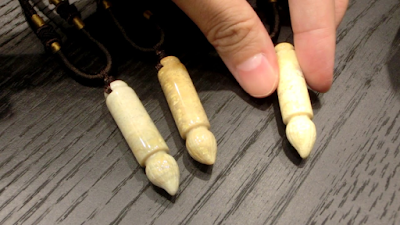 |
| Jade ornaments in the form of miniature Wenchang pens |
As another example of the “reincarnation” of the Bagatto’s tools, consider that the Fire Wand was just one of a set of four Tarot-inspired “elemental weapons” used by the Golden Dawn. The others were the Water Cup, the Earth “Pentacle” (a term used very loosely; Yeats’s featured a six-pointed star), and the Air Dagger. Although Waite’s Magician has a full-sized sword, and although Yeats himself owned a consecrated sword in addition to an Air Dagger, it was nevertheless the dagger that became the standard magical implement representing the Tarot suit of Swords. When Gerald Gardner created the Wiccan religion, he imported the Golden Dawn’s four elemental weapons but called the dagger an athame. Wikipedia has this to say about the etymology of that word.
The term athame derives, via a series of corruptions, from the late Latin artavus (“quill knife”), which is well attested in the oldest manuscripts of the Key of Solomon. It means “a small knife used for sharpening the pens of scribes” (“Cultellus acuendis calamis scriptorii”). Artavus is well-attested in medieval Latin, although it is not a common word. This explains why it was left untranslated in some French and Italian manuscripts, and ultimately became garbled in various manuscripts as artavo, artavus, arthana, artanus, arthany or arthame.
So the Bagatto’s pen knife evolved into a sword, and the sword into a dagger, which dagger was later given a new name which turns out to be a corruption of the Latin word for “pen knife.” Wikipedia says “quill knife,” implying that it was used for feather pens, but the Latin quotation given uses the word calamus, which properly refers to a reed pen. The parallel with the double-headed reed pen itself, which evolved into an ordinary magic wand and then back into the form of a double-headed pen, is striking. In both cases, the scribal tool evolved into a magical implement, temporarily losing its scribal identity and then fortuitously recovering it while still maintaining the magical character it had since acquired. While each step along the way seems to be driven by coincidence and error, the overall trajectory of the Tarot Magician is anything but random. Tomberg’s concept of the progressive “reincarnation” of the Book of Thoth seems to be right on the money. In particular, the Magician seems to be assiduously asserting his identity as Thoth himself, the reed-pen-wielding god of both magic and writing.
*
Well, that’s about enough for one post. Having taken a broad, diachronic look at the Magician, the next step will be to examine some of his specific instantiations in greater depth.


